The Super App Playbook: How to Build the Next Zomato or Swiggy
Dreaming of building a super app? This in-depth guide breaks down how apps like Zomato & Swiggy work, their tech stack, key features, and the roadmap to build your own. Master the skills at codercrafter.in!
Cracking the Code: How to Build a Super App Like Zomato or Swiggy
Let's be real. How many times have you opened Zomato, scrolled through restaurants, felt too lazy to decide, and then just opened Swiggy Instamart to order some chips and soda? Or maybe you booked a table for dinner through Zomato and then used their delivery service the next day?
You’ve just experienced the magic of a Super App.
These aren't just apps; they're ecosystems living in your pocket. They’ve fundamentally changed how we eat, shop, and live. For any aspiring entrepreneur or developer, the question is: How do you even begin to build something this massive?
Buckle up, because we're diving deep into the world of super apps. We'll break down the "how" and "what" and give you a realistic roadmap. And if you're serious about building the next big thing, stick around till the end because we’ve got something for you.
What Exactly Is a Super App? (Spoiler: It's Not Just a Food App)
In simple terms, a super app is a single, all-in-one application that offers a wide range of services that you’d otherwise need multiple separate apps for. Think of it as a digital Swiss Army knife.
Zomato started as a restaurant discovery and review platform. Swiggy was purely a food delivery service. Today?
Zomato: Food delivery, table reservations, grocery delivery (Zomato Instant), live events, and even nutrition tracking.
Swiggy: Food delivery, instant grocery delivery (Instamart), pick-up & drop service (Genie), and a subscription model (Swiggy One).
They’ve woven themselves into the fabric of your daily life. The goal? To become so indispensable that leaving the app feels like a chore.
The Secret Sauce: Core Features You CANNOT Ignore
Building a super app isn't about throwing a bunch of features together. It's about creating a seamless, integrated experience. Here’s the tech stack and features that form the backbone.
1. The User-Facing Magic (What the User Sees)
Intuitive Onboarding & Profiles: A slick, fast sign-up (think Google/Apple login). The user profile is the heart of it all—saved addresses, payment methods, order history, and preferences.
Geolocation & Real-Time Tracking: This is non-negotiable. Using GPS, the app must pinpoint your location, show nearby services, and most importantly, give you that satisfying, anxiety-reducing live order tracking map. Tech like Google Maps API is your best friend here.
Advanced Search & Discovery: A powerful search bar with filters (cuisine, cost, rating, dietary preferences) and a smart recommendation engine ("Because you ordered pizza...") are key to user retention.
Multi-Service Dashboard: The home screen shouldn't be cluttered. It needs a clean UI with clear tabs or sections for Food, Grocery, etc. Think of Swiggy's bottom navigation bar.
Rock-Solid Payment Gateway: You need to integrate multiple payment options—UPI, Credit/Debit Cards, Wallets, Net Banking. And it has to be flawless. A single failed payment can lose a customer forever. Razorpay and Stripe are popular choices in the ecosystem.
In-App Chat & Support: Direct communication between the user, the delivery partner, and support is crucial for resolving issues in real-time.
Loyalty & Gamification: This is the glue. Swiggy One and Zomato Pro are masterclasses in creating a subscription model that makes users feel special with benefits like free delivery, discounts, and priority support.
2. The Backend Beast (The Unseen Engine)
This is where the real complexity lies. If the frontend is the calm swan, the backend is the legs paddling furiously underwater.
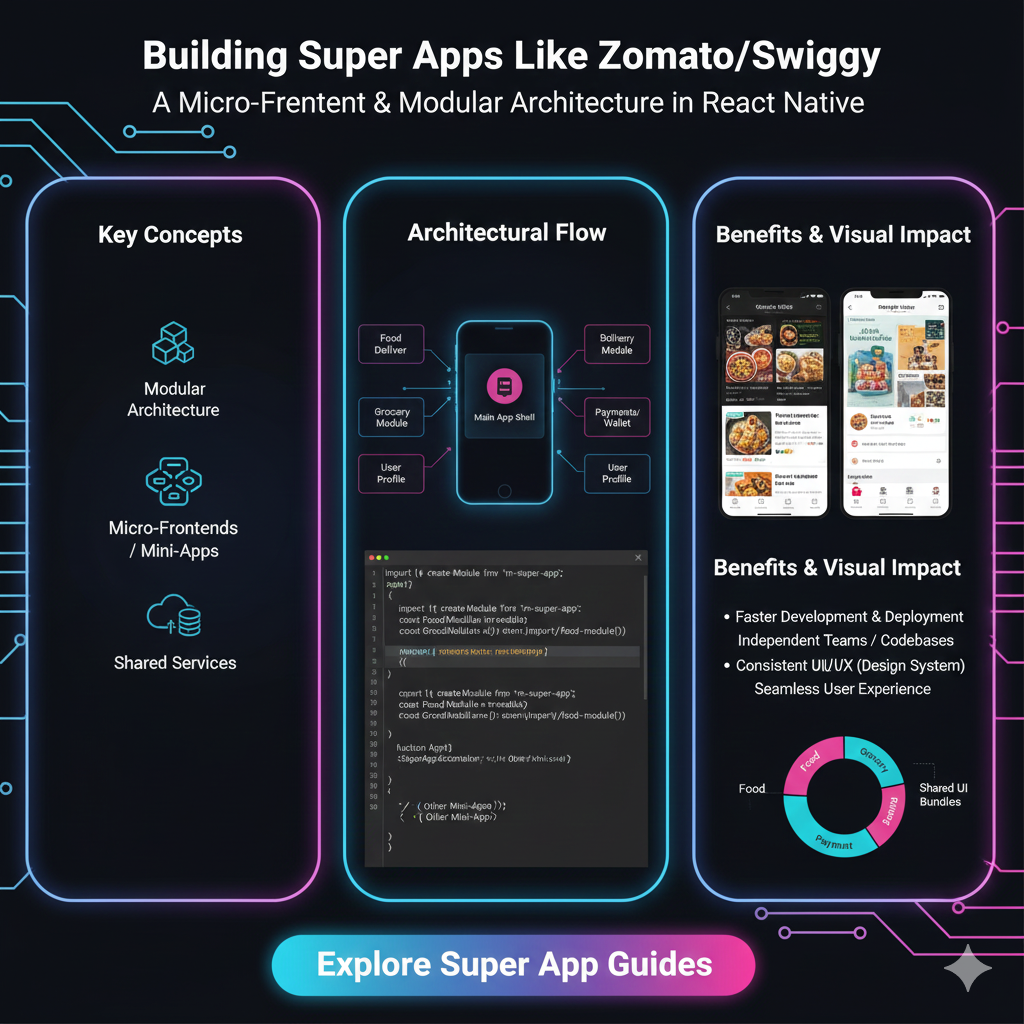
Microservices Architecture: Forget a giant, monolithic codebase. Modern super apps are built using a microservices architecture. This means each core service (User Management, Restaurant Search, Order Processing, Payments, Delivery Dispatch) is a separate, independent module. This allows teams to develop, deploy, and scale parts of the app without bringing the whole system down. To learn professional software development courses that dive deep into architectures like Microservices, Python Programming, and Full Stack Development, visit and enroll today at codercrafter.in.
The Database Dilemma: You're dealing with massive, diverse data. You might use a relational database (like PostgreSQL) for structured data (user info, orders) and a NoSQL database (like MongoDB) for unstructured data (menu images, reviews, logs).
Real-Time Data Processing: For live order tracking and notifications, you need technologies like WebSockets or server-sent events (SSE) to maintain a persistent, real-time connection between the app and your servers.
AI & Machine Learning: This is the brain. ML algorithms power your recommendation engine, predict delivery times, optimize delivery routes for riders, and even help in fraud detection.
Cloud Infrastructure: You need scalable, reliable, and secure hosting. AWS, Google Cloud, or Microsoft Azure are the go-to choices. They provide the firepower to handle millions of orders during peak times without a hiccup.
The Real-World Playbook: It's More Than Just Code
Building the app is one thing. Making it work in the real world is another ball game.
The Three-Sided Marketplace: You're not just building for the customer. You're managing a complex relationship between:
The End Customer (who wants food, fast and cheap).
The Restaurant/Store Partners (who want more orders and a smooth process).
The Delivery Fleet (who want fair pay and efficient routes).
Keeping all three sides happy is the ultimate business challenge.
The Hyperlocal Logistics Model: This is Swiggy's and Zomato's crown jewel. It's about creating a dense network of delivery partners who can fulfill orders from local stores within minutes. This involves complex algorithms for dispatch, batching, and route optimization.
Data is King: Every click, every search, every cancelled order is data. Super apps use this data to understand user behavior, predict demand, personalize experiences, and make strategic business decisions.
Your Roadmap to Building a Super App
So, you're still here and pumped? Here's a practical, step-by-step approach.
Niche Down & Dominate: You can't be a super app on day one. Zomato started with restaurant reviews. Swiggy started with food delivery. Find one core service you can execute perfectly. Solve one problem brilliantly.
Build an MVP (Minimum Viable Product): Your first version should have only the essential features. For a food delivery app, that's: search restaurants, view a menu, add to cart, pay, and track the order. Nothing more.
Adopt a Scalable Tech Stack from Day One: Even with an MVP, plan for scale. Using a cloud provider and a microservices-minded approach from the start will save you from a painful, expensive rewrite later. Mastering a scalable tech stack is what we teach in our MERN Stack and Full Stack Development programs at codercrafter.in.
Focus Relentlessly on User Experience (UX): The app must be fast, intuitive, and reliable. A half-second delay in loading can cause users to abandon the app.
Gather, Analyze, Iterate: Launch your MVP, get real users, collect their feedback, and keep improving. Add new features based on what your data tells you, not just on a hunch.
Expand Horizontally: Once you have a strong user base and a working model for your core service, then you can start adding adjacent services. Food delivery to grocery delivery is a natural expansion.
FAQs: Your Burning Questions, Answered
Q1: How much does it cost to build an app like Swiggy?
There's no one-size-fits-all answer, but for a full-featured MVP, you're looking at a significant investment, potentially ranging from $80,000 to $200,000+ depending on the team's location, tech stack, and feature complexity. This includes development, design, backend, and initial testing.
Q2: What is the best technology stack for a super app?
There's no single "best" stack, but a modern, powerful combination is:
Frontend: React Native or Flutter (for cross-platform apps)
Backend: Node.js, Python (Django), or Go
Database: PostgreSQL (SQL) & MongoDB (NoSQL)
Cloud: AWS, Google Cloud, or Azure
Real-Time: WebSockets, Firebase
Q3: How do super apps like Zomato make money?
Their revenue streams are diversified:
Commissions from restaurants/stores on every order.
Delivery fees from customers.
Advertising and promotional spots within the app for restaurants.
Subscription models (e.g., Zomato Pro, Swiggy One).
Conclusion: The Future is "Super"
The age of single-purpose apps is fading. The future belongs to integrated, convenient, and intelligent platforms that solve multiple problems for users in a single, trusted environment.
Building a super app is a marathon, not a sprint. It requires a visionary idea, a rock-solid technical foundation, a deep understanding of the market, and relentless execution.
It all starts with writing that first line of code. The journey from a simple application to a digital empire is complex, challenging, and incredibly rewarding. If you're ready to start that journey and want to build the technical prowess to make it happen, you need the right foundation.
To learn professional software development courses such as Python Programming, Full Stack Development, and MERN Stack, visit and enroll today at codercrafter.in. Let's build the future, together.