Master Controlled Components in React: Complete Guide with Examples & Best Practices | CoderCrafter
Learn how to use Controlled Components in React to build better forms with validation, real-time updates, and predictable state management. Includes code examples, best practices, and FAQs.
Why Your Forms Are Frustrating Your Users (And How to Fix Them)
Hey there, fellow devs! 👋 Ever built a form in React only to realize it's behaving like a rebellious teenager - doing whatever it wants, ignoring your instructions, and making everyone's life difficult? You're not alone. We've all been there, staring at our screens wondering why our simple login form suddenly turned into a coding nightmare.
Here's the truth: form handling is one of the most crucial yet misunderstood aspects of modern web development. Get it right, and users flow through your application seamlessly. Get it wrong, and you've created a digital brick wall.
Today, we're diving deep into Controlled Components - React's secret weapon for building forms that actually work the way you intend. This isn't just another tutorial that scratches the surface. We're going to unpack everything: what they really are, why they matter, practical examples you can use today, real-world scenarios, best practices, and common pitfalls.
By the way, if you're serious about leveling up your React skills, you should check out the comprehensive Full Stack Development and MERN Stack courses at CoderCrafter.in. They cover these concepts in depth with real projects and expert mentorship - definitely worth exploring if you want to become a pro.
What Are Controlled Components? (Breaking Down the Buzzword)
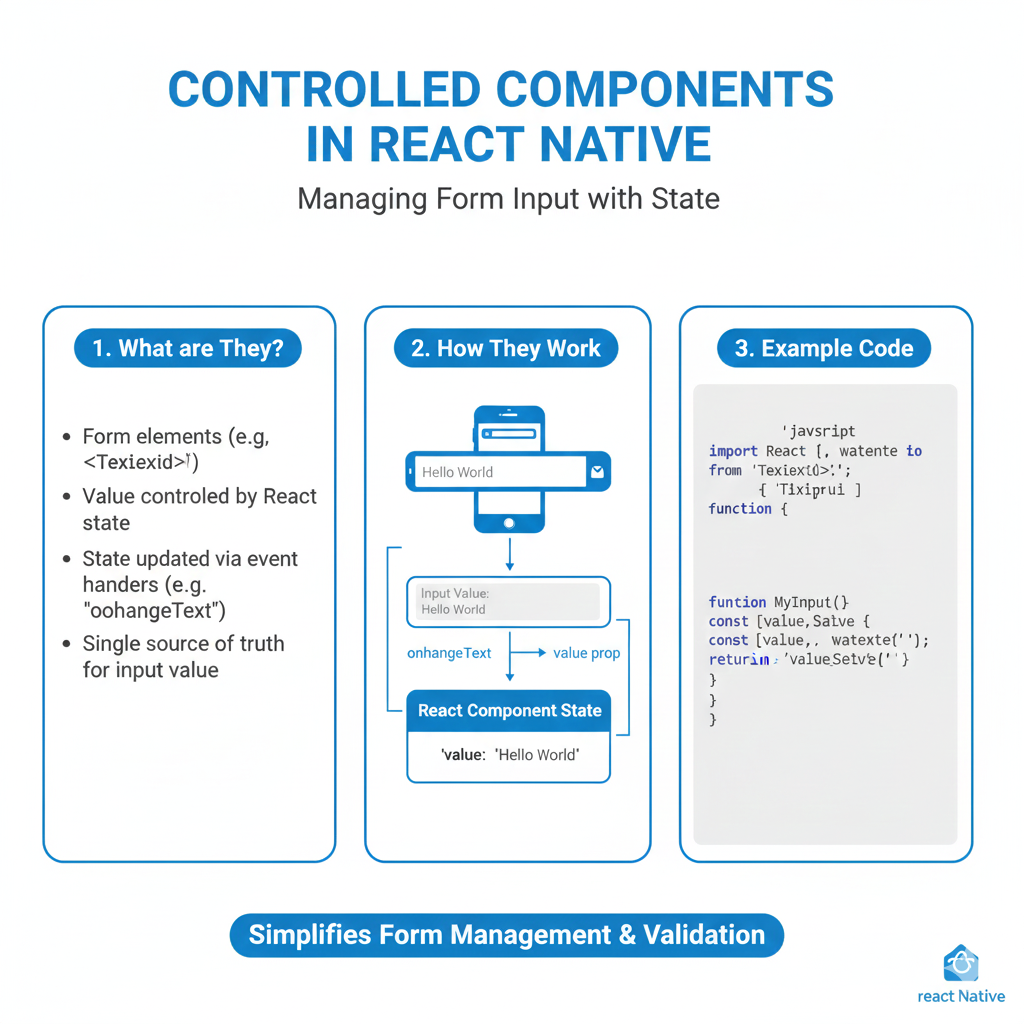
Let's cut through the jargon. In plain English, a controlled component is simply a form element whose value is controlled by React state. Think of it like this: instead of the browser's DOM managing the input value, React becomes the single source of truth.
Here's the crucial distinction:
Uncontrolled Components: Like letting a toddler run wild in a candy store. The DOM handles the element's state, and you only check in occasionally.
Controlled Components: Like having a GPS tracking system on that same toddler. You know exactly where they are at all times, and you can redirect them if they're heading toward trouble.
With uncontrolled components, you might use ref to pull values from the DOM when needed (like when the form submits). With controlled components, every single keystroke updates React state, and that state update triggers a re-render that sets the input's value.
The "Aha!" Moment: Controlled Components in Action
Let me walk you through a simple example that changed how I think about forms forever. We'll build a basic text input that shows you exactly what's happening under the hood:
javascript
import { useState } from 'react';

function ControlledInputExample() {
  // This is where the magic happens
  const [inputValue, setInputValue] = useState('');

  const handleChange = (event) => {
    // Every keystroke updates our React state
    setInputValue(event.target.value);
    console.log(`Current value: ${event.target.value}`);
  };

  return (
    <div>
      <h3>Type something and watch the magic:</h3>
      {/* The input value is CONTROLLED by React state */}
      <input
        type="text"
        value={inputValue}
        onChange={handleChange}
        placeholder="Start typing..."
      />
      <p>You typed: <strong>{inputValue}</strong></p>
    </div>
  );
}
See what's happening here? The value attribute of our input is set to inputValue (our state). When the user types, onChange fires, updates the state with setInputValue, and React re-renders the component with the new value. It's a beautiful, predictable cycle.
Why Bother With All This Control?
You might be thinking: "This seems like extra work. Why not just let the DOM handle it?" Great question! Here's why controlled components are worth the effort:
Immediate Validation: You can validate on every change, not just on submit. Trying to create a password strength meter? This is your golden ticket.
Conditional UI Updates: Want to show/hide fields based on what the user has typed? Controlled components make this trivial.
Complex Form Logic: Need to format phone numbers as the user types? Or automatically add dashes to credit card numbers? React state gives you total control.
Predictable Testing: Since everything flows through state, testing becomes straightforward and deterministic.
Integration with State Management: When using tools like Redux or Context API, controlled components fit right into the data flow.
Real-World Example: Building a Professional Contact Form
Let's build something you'd actually use in a real project. Here's a complete contact form with multiple input types, validation, and submission handling:
javascript
import { useState } from 'react';

function ProfessionalContactForm() {
  // Form state as a single object - keeps things organized
  const [formData, setFormData] = useState({
    name: '',
    email: '',
    message: '',
    subscription: false
  });

  // Validation state
  const [errors, setErrors] = useState({});

  // Handle changes for all inputs
  const handleInputChange = (e) => {
    const { name, value, type, checked } = e.target;

    setFormData(prev => ({
      ...prev,
      [name]: type === 'checkbox' ? checked : value
    }));

    // Clear error for this field when user starts typing
    if (errors[name]) {
      setErrors(prev => ({
        ...prev,
        [name]: ''
      }));
    }
  };

  // Validate form
  const validateForm = () => {
    const newErrors = {};

    if (!formData.name.trim()) {
      newErrors.name = 'Name is required';
    }

    if (!formData.email) {
      newErrors.email = 'Email is required';
    } else if (!/\S+@\S+\.\S+/.test(formData.email)) {
      newErrors.email = 'Email is invalid';
    }

    if (!formData.message.trim()) {
      newErrors.message = 'Message is required';
    }

    return newErrors;
  };

  // Handle form submission
  const handleSubmit = (e) => {
    e.preventDefault();

    const formErrors = validateForm();

    if (Object.keys(formErrors).length === 0) {
      // Form is valid - submit data
      console.log('Form submitted:', formData);
      alert('Message sent successfully!');
      // Reset form
      setFormData({
        name: '',
        email: '',
        message: '',
        subscription: false
      });
    } else {
      // Form has errors
      setErrors(formErrors);
    }
  };

  return (
    <form onSubmit={handleSubmit} className="contact-form">
      <h2>Get in Touch</h2>

      <div className="form-group">
        <label htmlFor="name">Full Name *</label>
        <input
          type="text"
          id="name"
          name="name"
          value={formData.name}
          onChange={handleInputChange}
          className={errors.name ? 'error' : ''}
          placeholder="Enter your full name"
        />
        {errors.name && <span className="error-message">{errors.name}</span>}
      </div>

      <div className="form-group">
        <label htmlFor="email">Email Address *</label>
        <input
          type="email"
          id="email"
          name="email"
          value={formData.email}
          onChange={handleInputChange}
          className={errors.email ? 'error' : ''}
          placeholder="you@example.com"
        />
        {errors.email && <span className="error-message">{errors.email}</span>}
      </div>

      <div className="form-group">
        <label htmlFor="message">Your Message *</label>
        <textarea
          id="message"
          name="message"
          value={formData.message}
          onChange={handleInputChange}
          className={errors.message ? 'error' : ''}
          placeholder="What would you like to say?"
          rows="5"
        />
        {errors.message && <span className="error-message">{errors.message}</span>}
      </div>

      <div className="form-group checkbox-group">
        <input
          type="checkbox"
          id="subscription"
          name="subscription"
          checked={formData.subscription}
          onChange={handleInputChange}
        />
        <label htmlFor="subscription">Subscribe to our newsletter</label>
      </div>

      <button type="submit" className="submit-btn">Send Message</button>
    </form>
  );
}
This example demonstrates several key patterns:
Centralized state management with a single
formDataobjectUnified change handler that works for different input types
Real-time validation with immediate user feedback
Conditional styling based on validation state
When Should You Use Controlled Components?
Honestly? Most of the time. But specifically, reach for controlled components when you need:
Form validation (especially as-you-type validation)
Conditional form logic (show field B only if field A has a certain value)
Complex state transformations (formatting, calculations, etc.)
Integration with application state (when form data needs to be accessed elsewhere)
Building reusable form components for your component library
There's a small performance cost since every keystroke triggers a re-render, but for the vast majority of forms, this is negligible. The developer experience and user experience benefits far outweigh any micro-optimization concerns.
Pro Tips and Best Practices
After building dozens (maybe hundreds) of forms with controlled components, here are my hard-earned lessons:
1. Group Related Form State
javascript
// Instead of this:
const [name, setName] = useState('');
const [email, setEmail] = useState('');
const [password, setPassword] = useState('');

// Do this:
const [formData, setFormData] = useState({
  name: '',
  email: '',
  password: ''
});
2. Create Custom Hooks for Complex Forms
javascript
function useForm(initialValues) {
  const [values, setValues] = useState(initialValues);

  const handleChange = (e) => {
    const { name, value, type, checked } = e.target;
    setValues(prev => ({
      ...prev,
      [name]: type === 'checkbox' ? checked : value
    }));
  };

  const resetForm = () => {
    setValues(initialValues);
  };

  return [values, handleChange, resetForm];
}
3. Use the Right Input Types
HTML5 gives us tons of built-in input types that work beautifully with controlled components: email, tel, date, range, color, etc. These provide native browser validation and special UI on mobile devices.
4. Debounce Expensive Operations
If you're doing heavy computation on every keystroke (like API calls for autocomplete), use debouncing:
javascript
import { useCallback } from 'react';
import debounce from 'lodash/debounce';

function SearchForm() {
  const [query, setQuery] = useState('');

  // Debounced search function
  const debouncedSearch = useCallback(
    debounce((searchTerm) => {
      // API call or heavy computation here
      console.log('Searching for:', searchTerm);
    }, 500),
    []
  );

  const handleChange = (e) => {
    const value = e.target.value;
    setQuery(value);
    debouncedSearch(value);
  };

  return <input value={query} onChange={handleChange} />;
}
FAQs: Your Controlled Components Questions Answered
Q: Are controlled components slower than uncontrolled components?
A: In practice, the difference is negligible for most forms. The React reconciliation process is highly optimized. Only worry about performance if you're building forms with hundreds of fields that update simultaneously.
Q: When should I use uncontrolled components?
A: Use uncontrolled components for simple forms where you only need the values on submit, or for integrating with non-React libraries that need direct DOM access. File inputs are also typically uncontrolled since their value is read-only.
Q: How do I handle large forms without performance issues?
A: Consider breaking them into smaller components, using React.memo for expensive re-renders, or moving to a form library like Formik or React Hook Form that's optimized for performance.
Q: Can I mix controlled and uncontrolled components?
A: Technically yes, but it's an anti-pattern that leads to confusing code. Stick to one approach per form for consistency.
Q: What about third-party form libraries?
A: Libraries like Formik and React Hook Form are excellent and use controlled components under the hood. They abstract away the boilerplate while keeping the benefits of React-controlled state.
Q: Where can I learn more about advanced React patterns like this?
A: For comprehensive learning on React and full-stack development, check out the professional courses at CoderCrafter.in. Their Full Stack Development and MERN Stack programs cover these concepts in depth with real-world projects and expert guidance.
Wrapping Up: Embrace the Control
Controlled components might feel like overkill at first, but once you get the hang of them, you'll wonder how you ever built forms without them. They transform form handling from a frustrating chore into a predictable, testable, and maintainable part of your React applications.
Remember: controlled components give you the superpower of complete predictability. You always know what's in your form state, and you can manipulate it however you need. That's powerful stuff when you're building production applications that real users depend on.
The journey to mastering React involves understanding these fundamental patterns deeply. If you're looking to accelerate your learning with structured courses and real project experience, consider exploring the software development programs at CoderCrafter.in. They offer professional training in Python Programming, Full Stack Development, MERN Stack, and more with industry expert mentorship.
Got questions about controlled components? Built something cool with them? Share your experiences in the comments below! And if you found this guide helpful, share it with a developer friend who's struggling with their forms.