Pixel-Perfect UI: The 2025 Guide to Flawless Design & Best Practices
Master pixel-perfect UI design. Our in-depth guide covers definitions, best practices, real-world examples, and essential tools to create crisp, professional interfaces that users love. Start building better today.
Have you ever looked at a website or app and just felt like something was… off? Maybe the icons looked a little fuzzy, the text didn’t quite line up, or buttons seemed to jump around? That’s the opposite of pixel-perfect UI. Today, we’re diving deep into what it means to create crisp, precise interfaces that not only look stunning but feel effortless to use. This isn’t just for designers—anyone who builds for the web can benefit from mastering these principles.
What Exactly Is Pixel-Perfect UI?
Let’s cut through the jargon. Pixel-perfect UI is an approach where every single element in your interface is intentionally placed and razor-sharp . It means your buttons, text, icons, and images align perfectly with an invisible grid, rendering without any blurriness or weird misalignments, no matter what screen they’re viewed on .
Think of it as the difference between a hand-drawn sketch and a precision-engineered blueprint. One has charm, but the other guarantees consistency, clarity, and a professional polish that users instinctively trust . It’s the meticulous attention to detail that transforms a good design into a great one.
Why Bother? The Real-World Impact of Precision
You might think, “Won’t users just scroll past a button that’s 2 pixels off?” Maybe. But collectively, these small imperfections degrade the user experience. Here’s why pixel perfection matters:
Professionalism & Trust: A polished interface signals quality and care. It builds user confidence in your product or brand .
Enhanced Usability: Consistent spacing and clear alignment make interfaces easier to scan and navigate, reducing cognitive load .
Developer Handoff Harmony: Precise designs with clear specs drastically reduce back-and-forth with developers, speeding up the entire build process.
The business case is strong. Research indicates that companies with mature, detail-oriented design processes see significant advantages, including faster revenue growth and higher customer retention compared to their peers .
Your Toolkit for Pixel Perfection: Best Practices
Achieving this level of detail isn’t about having a superhuman eye; it’s about using the right systems and tools. Here’s your practical checklist.
1. Embrace the Grid (Your New Best Friend)
Start every project by defining a grid system, like an 8-pixel or 4-pixel baseline . This isn’t a constraint; it’s your secret weapon for creating rhythm and balance. Align everything—margins, padding, element sizes—to this grid. It ensures your design has a structured, harmonious foundation that scales beautifully.
2. Master Typography & Spacing
Inconsistent text and random gaps are the fastest ways to break the illusion of perfection.
Typography: Use relative units (like
remorem) for font sizes to ensure clean scaling across devices. Maintain strict consistency in line-height, letter spacing, and font weights .Spacing: Define a spacing scale (e.g., 4px, 8px, 16px, 24px) and stick to it religiously for margins and padding. This creates visual harmony and eliminates guesswork .
3. Use High-Fidelity Assets
Blurry icons or pixelated images ruin a crisp layout. Always use vector-based graphics (SVG) for icons and logos so they stay sharp at any resolution . For images, ensure they are high-resolution and optimized for modern, high-DPI (Retina) displays.
4. Leverage Your Design Tools
Modern design software is built for this. Enable pixel-snapping in Figma, Sketch, or Adobe XD to make elements snap to your pixel grid automatically. Pay attention to anti-aliasing settings to keep text and graphic edges smooth .
5. Build a Design System
For larger projects, a design system is non-negotiable. It’s a library of reusable, pre-defined components (buttons, input fields, modals) with strict rules. This guarantees consistency across every screen and allows your team to build interfaces faster .
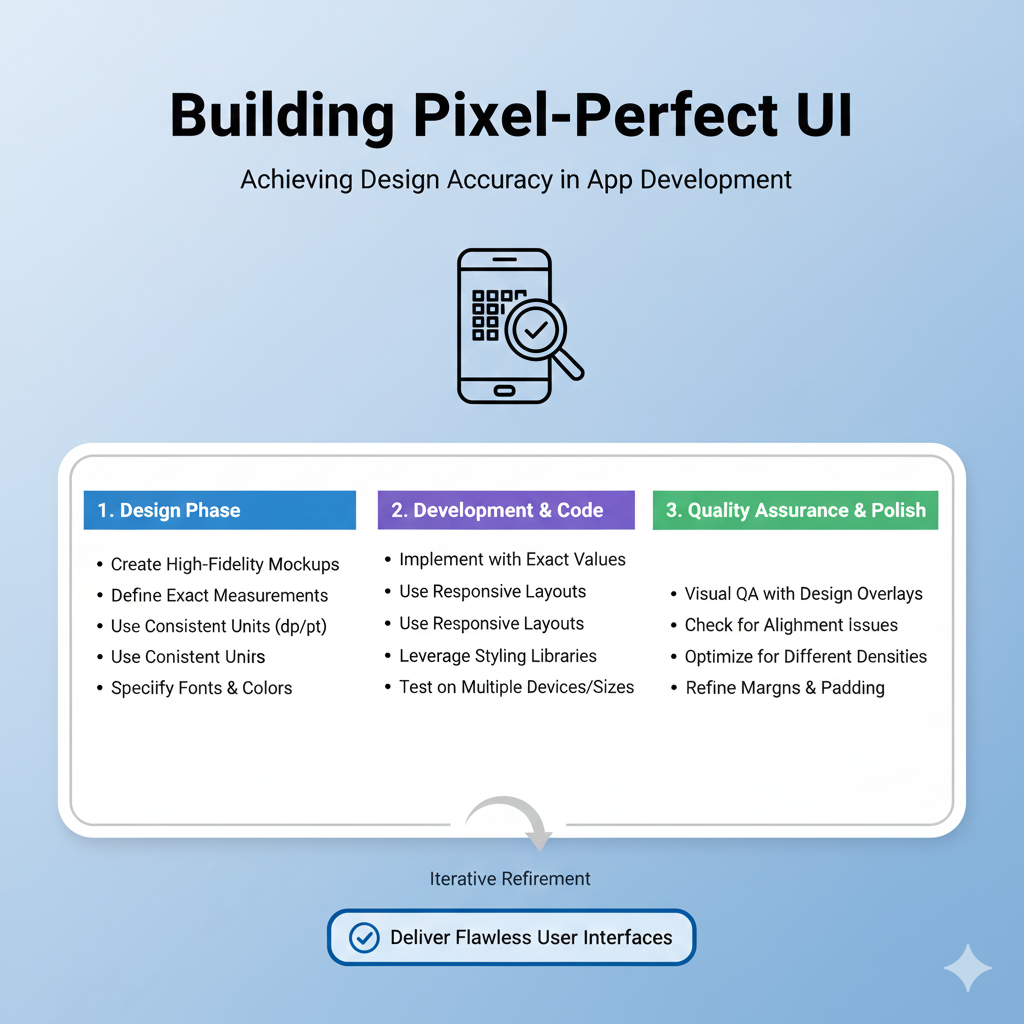
The Essential Workflow: From Vision to Validation
A structured process is key to maintaining precision from start to finish. Following a phased approach helps avoid costly rework. For instance, one design agency uses a six-phase process that moves from discovery and wireframing to visual design and continuous validation, ensuring every pixel serves a user goal and a business metric .
Real-World Use Case: Learning by Replication
One of the most effective ways to train your eye for detail is through UI replication challenges. A designer documented her 15-day journey of recreating stunning interfaces from real apps pixel-by-pixel .
She started slow, spending hours on a single screen, but by day 15, she could build a complex dashboard in under an hour. The takeaway? This practice wasn’t about copying—it was about reverse-engineering excellence, understanding spacing, hierarchy, and color choices on a deeper level. It’s like a musician practicing scales; you internalize the patterns until they become second nature.
Pro-Tip Corner: Color Mode Matters (CMYK vs. RGB)
Here’s a technical pitfall that can catch even seasoned designers off-guard, especially when assets move between digital and print. The vibrancy of your UI colors depends on using the correct color model:
RGB (Red, Green, Blue): The absolute standard for anything digital (websites, apps, social media). It’s an additive color model based on light, capable of producing bright, glowing colors.
CMYK (Cyan, Magenta, Yellow, Key/Black): Used exclusively for physical printing (business cards, t-shirts, brochures). It’s a subtractive model using ink.
The golden rule: Always design digital UI in RGB. If you start in CMYK or use a CMYK asset, your colors will appear dull and muted on screens. Need to check or convert a file? Professional tools like Adobe Photoshop have built-in “Convert to Profile” functions for accurate transformation . For a quick and easy conversion, you can also use online tools like the CMYK to RGB converter on CoderCrafter.in.
FAQs: Your Pixel-Perfect Questions, Answered
Q: Isn’t pixel-perfect design obsolete with so many different screen sizes?
A: Not at all. The principle isn’t about forcing one static size; it’s about precision at every breakpoint. A responsive design should be pixel-perfect on a mobile, tablet, and desktop.
Q: How do I ensure developers can build my pixel-perfect design accurately?
A: Communication is key. Use tools like Zeplin, Figma Dev Mode, or Storybook that generate precise specs for spacing, fonts, and assets. A short Loom video walking through interactive states can also be incredibly helpful .
Q: Where do I start if my current designs are messy?
A. Begin with a UI audit. Pick one of your screens and critique it against the best practices above. Then, try the 15-day replication challenge mentioned earlier to rapidly train your eye .
Conclusion: Precision is a Practice
Building pixel-perfect UI is less about innate talent and more about discipline, systems, and a commitment to craft. It’s the accumulation of a thousand small, correct decisions that result in an interface that feels intuitive, trustworthy, and effortless.
Start small. Pick one practice from this guide—like implementing an 8px grid or cleaning up your typography scale—and apply it to your next project. The difference will be noticeable.
The journey to mastering these digital craftsmanship skills is continuous. To learn professional software development courses that teach you how to build these impeccable interfaces from the ground up, such as Python Programming, Full-Stak Development, and MERN Stack, visit and enroll today at codercrafter.in. You'll gain the technical expertise to turn pixel-perfect designs into robust, functional reality.