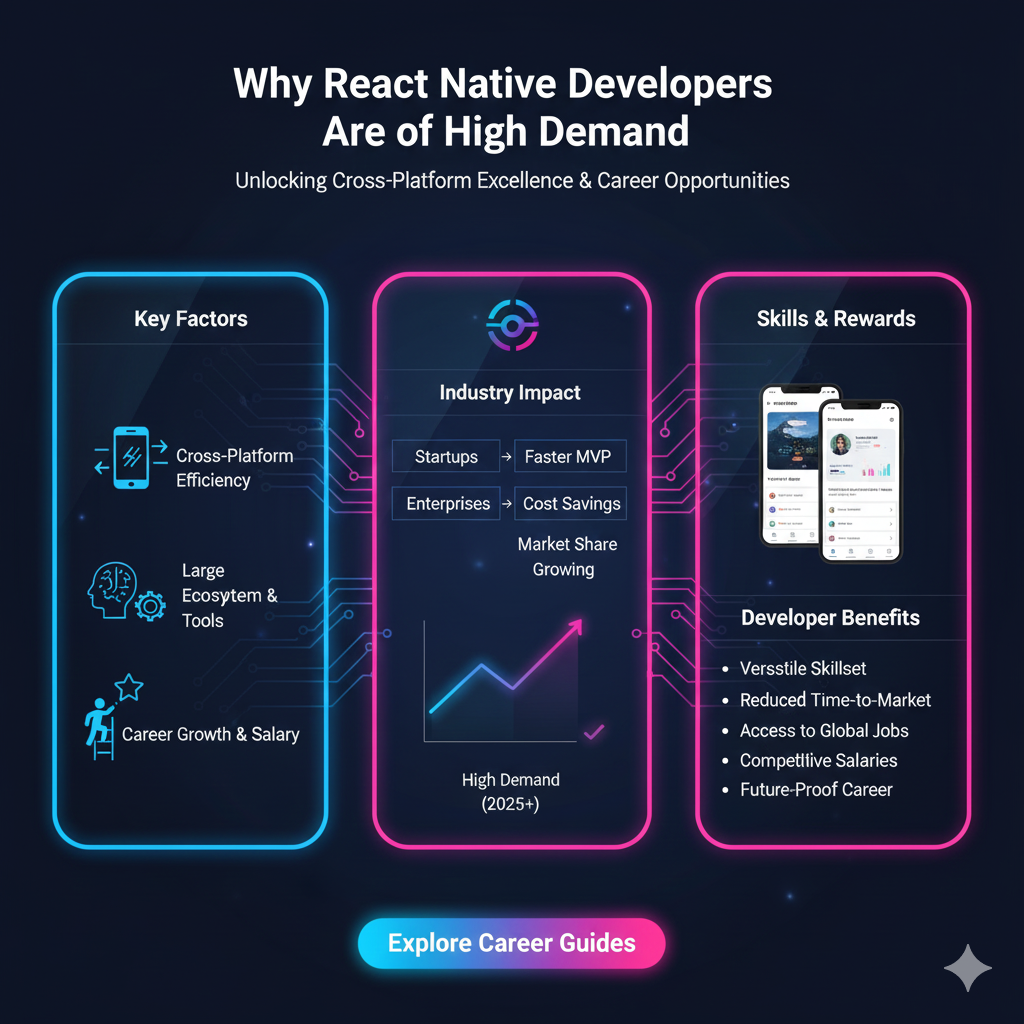
Discover why React Native developer jobs are booming. Learn the benefits for businesses, essential skills, real-world app examples, and how to launch your own high-paying career. To learn professional software development, enroll at CoderCrafter.in.
Why React Native Developers Are in High Demand: Your 2025 Career Goldmine
Let's be real. You’re scrolling through job boards, and you see it everywhere—"Hiring React Native Developers." Your LinkedIn feed is flooded with recruiters desperate for this specific skill set. You’ve probably wondered, "What's the big deal? Is this just another tech fad, or is it the real deal?"
Spoiler alert: It's very, very real.
React Native isn't just a buzzword; it's a fundamental shift in how companies build mobile apps. And this shift has created a massive gold rush for developers who know their way around it. But why? What makes this particular framework so special that everyone from hungry startups to tech giants like Meta and Microsoft are betting big on it?
Buckle up, because we're diving deep into the world of React Native. We'll break down why it's the rockstar of cross-platform development, why businesses are obsessed with it, and most importantly, how you can position yourself to grab these high-demand, high-paying jobs.
First Things First: What Exactly is React Native?
In simple terms, React Native is an open-source framework created by Facebook (now Meta) that lets you build truly native mobile apps using one language you probably already know and love: JavaScript.
Hold on, "native"? But you're using JavaScript? Yep, that’s the magic.
Think of it like this: Before React Native, if a company wanted an app for both iOS and Android, they basically had to build two separate apps from scratch. They’d need one team of developers who are wizards in Swift (for iOS) and another team of gurus in Kotlin (for Android). Double the time, double the people, double the money. Ouch.
React Native swoops in and says, "Nah, we can do better." It allows developers to write most of the code once, in JavaScript and React.js, and then it renders that code into native components. This means your app isn’t a clunky web view stuffed inside a mobile shell—it uses the same building blocks as an app built purely in Swift or Kotlin. The result? An app that looks, feels, and performs like a native app.
The Business Case: Why Companies Are Head Over Heels
This isn't just a technical win for developers; it's a business no-brainer. Here’s why CEOs and product managers are pushing for React Native:
1. Code Reusability: The "Build Once, Run Anywhere" Dream
This is the big one. Studies and countless developer testimonials show that you can reuse anywhere from 80% to 90% of your codebase between iOS and Android. This translates directly into:
Faster Time-to-Market: You can launch your app on both platforms almost simultaneously. In today's fast-paced world, getting your product out first can be the difference between leading the market and playing catch-up.
Reduced Development Costs: Why pay two teams when you can pay one? This cost efficiency is a massive driver, especially for startups and SMEs with limited budgets.
2. A Truly Native Look and Feel
Earlier cross-platform solutions often resulted in apps that felt "off." React Native bridges this gap by using native APIs and components. Your iOS app will follow iOS design guidelines (Cupertino), and your Android app will follow Material Design principles, all from the same codebase. Users get a seamless, platform-appropriate experience.
3. The Power of "Hot Reloading"
This is a developer superpower. Hot reloading lets you see the changes you make to your code instantly in the app simulator or on your physical device, without rebuilding the entire application. It cuts down development time drastically and makes the debugging process infinitely less painful. It’s the kind of quality-of-life feature that developers fall in love with.
4. A Massive, Thriving Community
React Native is backed by Meta and, more importantly, a gigantic global community of developers. What does this mean for a business?
Faster Problem-Solving: Stuck on a bug? Chances are, someone has already solved it on Stack Overflow or GitHub.
A Wealth of Libraries: Need a specific feature? There's probably a pre-built, open-source library (a "package") for that, saving you days of development work.
Constant Innovation: The framework is constantly being improved and updated by thousands of contributors worldwide.
Real-World Proof: Apps You Use Every Day
If you're still skeptical, just look at your phone. Some of the most popular apps globally are built with React Native.
Facebook & Facebook Ads Manager: The OG that started it all. They built it for their own needs, proving it could handle a massive, complex application.
Instagram: Meta migrated Instagram to React Native, achieving a massive code reuse and streamlining their development process.
Shopify: The e-commerce giant has fully embraced React Native for their mobile apps, empowering millions of merchants.
Discord: Known for its smooth performance and real-time features, Discord is a testament to what React Native can achieve.
Pinterest, Uber Eats, Tesla: The list goes on and includes giants in tech, automotive, and food delivery.
When companies of this caliber stake their mobile presence on React Native, you know it's a proven technology.
The Developer's Playground: Why YOU Should Care
Okay, so it's great for businesses. But why is it a career jackpot for you?
High Demand, High Salaries: The simple economics of supply and demand. The demand for skilled React Native developers far outstrips the current supply, which drives up salaries and makes you a highly sought-after candidate.
Leverage Your Web Skills: If you already know JavaScript and React, you’re already halfway there. The learning curve is significantly smaller than picking up two completely new native languages. This allows you to break into the lucrative mobile app development space faster.
Versatility is King: Being a React Native developer makes you a versatile full-stack player. You can work on the web frontend with React and the mobile frontend with React Native, making you an invaluable asset to any team. To truly master this full-stack versatility with professional-grade training, consider exploring courses like the MERN Stack program at CoderCrafter.in, which provides a holistic path to becoming a industry-ready developer.
What Skills Do You Need to Become a React Native Pro?
To stand out, you need more than just the basics. Here’s a quick rundown:
Core Fundamentals: Strong JavaScript (ES6+) is non-negotiable. A solid grasp of React concepts (JSX, Components, State, Props, Hooks) is the foundation.
React Native Specifics: Navigation (React Navigation is the go-to), State Management (Redux, MobX, or Context API), and working with Native Modules for device-specific features (camera, GPS, etc.).
The Ecosystem: Familiarity with debugging tools, package managers (npm/yarn), and connecting to APIs (REST or GraphQL).
FAQs: Your Burning Questions, Answered
Q1: Is React Native going to die with new competitors like Flutter?
A: Absolutely not. While Flutter is a strong competitor, React Native's massive community, maturity, and JavaScript foundation give it a entrenched position. The demand for both is high, and the market is big enough for both to thrive. It's a healthy competition, not a death sentence.
Q2: Can React Native build complex, performance-heavy apps like games?
A: For most typical business apps (social media, e-commerce, productivity), React Native is perfectly capable. However, for graphics-intensive applications like high-end 3D games, you might still be better off with fully native development. But for the vast majority of apps on the app store, it’s more than enough.
Q3: How do I start learning React Native?
A: Start with a solid foundation in JavaScript and React. Then, dive into the official React Native documentation—it's excellent. Build small, simple projects (a to-do list, a weather app) and gradually increase complexity. For a structured, industry-focused learning path with mentorship and real-world projects, a dedicated course can fast-track your journey. For instance, to learn professional software development courses such as Python Programming, Full Stack Development, and MERN Stack, visit and enroll today at codercrafter.in to build a robust skill set.
Conclusion: The Future is Cross-Platform
The trend is clear. Businesses are prioritizing efficiency, speed, and cost-effectiveness without compromising on user experience. React Native delivers precisely on that promise. It has moved from a "risky experiment" to a mainstream, enterprise-ready solution.
For developers, this isn't just a passing trend to ignore. It represents a clear pathway to a rewarding, future-proof career. By investing your time in learning React Native, you're not just learning a framework; you're acquiring a skill that will remain relevant and highly valuable for years to come.
The demand is here, and it's not slowing down. The only question is, are you ready to be a part of it?
Ready to build the next big thing? Start your journey today.