Stuck in state management hell? Explore the best state management libraries for React, Vue, and more in 2025. We break down Zustand, Redux Toolkit, and others with real-world use cases.
Let’s be real. If you’ve spent more than five minutes in web development, you’ve felt the pain. Your app starts simple—a few components, a couple of buttons. Then, boom. You’re passing props through five levels of components (prop drilling, anyone?), lifting state up until your head spins, and suddenly a simple “update user profile” feels like performing open-heart surgery with spaghetti code.
State management. It’s the backbone of any interactive application, and choosing the wrong tool can turn your project into a maintenance nightmare. But with a million libraries screaming for your attention (Redux! Zustand! Jotai! Context! MobX!), how do you even decide?
Take a deep breath. We’re going to cut through the hype. This isn’t about what’s “coolest” or what some influencer tweeted. This is a pragmatic, in-depth look at the best state management solutions in 2025, based on community adoption, developer experience, and real-world performance. By the end, you’ll know exactly which tool to reach for.
What Even Is State Management? (In Plain English)
Think of your app’s state as its memory. It’s everything it needs to “remember” to function: Is the user logged in? What’s in their shopping cart? What theme did they pick? Is this modal open?
State management is simply the architecture you choose to store, access, and update this memory across your entire application. A good system makes this predictable and easy. A bad one makes it chaotic and bug-prone.
The 2025 Line-Up: Your State Management Toolbox
Gone are the days of one-size-fits-all. In 2025, it’s about picking the right tool for the job. Here’s the breakdown.
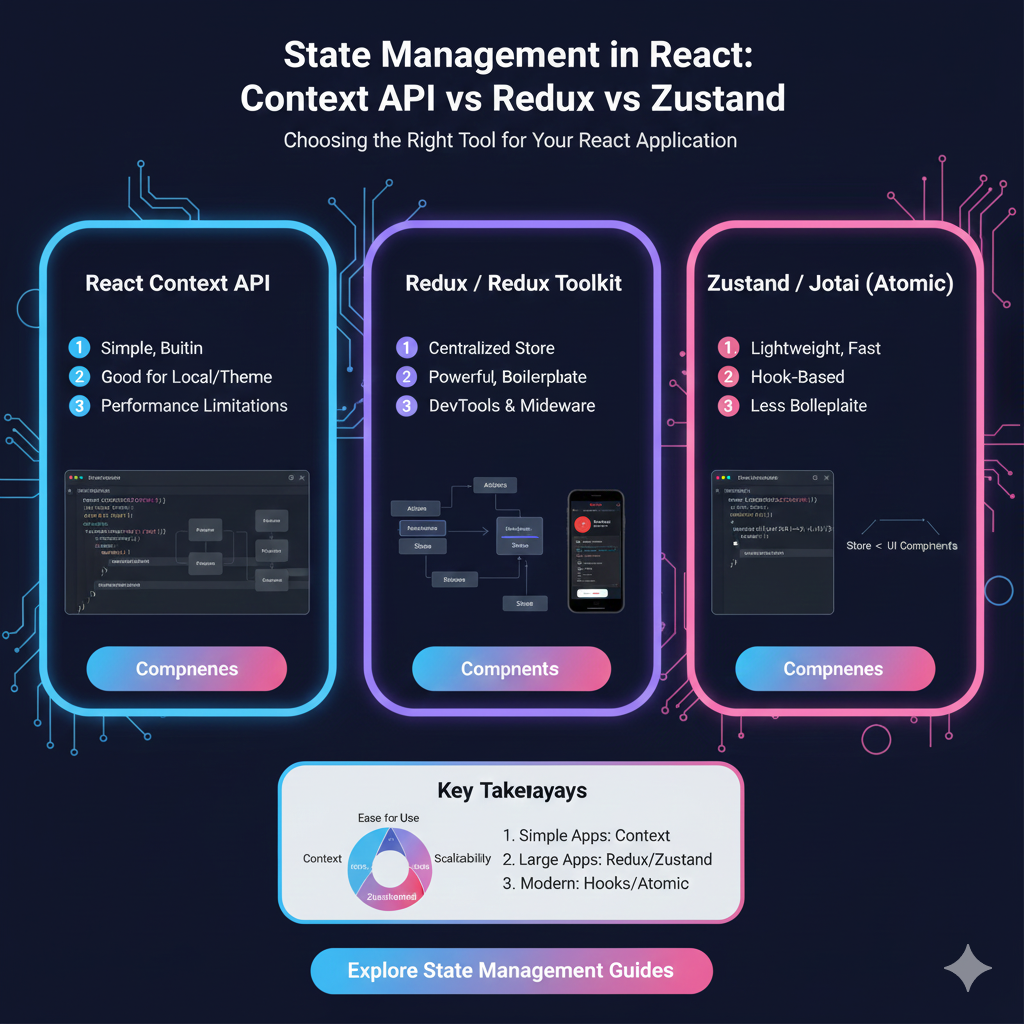
1. Zustand: The Minimalist Powerhouse (The Fan Favorite)
If there’s one library that has absolutely dominated the conversation in the last few years, it’s Zustand (German for "state"). It embodies the modern React philosophy: simple, composable, and incredibly efficient.
What it is: A bare-bones, global state manager that uses a hook-based API. You create a store, and any component can subscribe to the pieces of state it needs.
Why it’s everywhere in 2025:
Dead Simple API: You’ll set up a store in under 10 lines of code. No providers, no boilerplate.
No Wrapper Components: Your component tree stays clean. No
<Provider>needed.Direct Mutations: You update state by calling a function like
useStore.getState().updateUser(). It feels intuitive.Tiny Bundle Size: ~1 kB. Basically negligible.
Real-World Use Case: Perfect for theme settings (light/dark mode), user authentication state, or a complex multi-step form where inputs are needed across different sections. It’s the go-to for medium-complexity apps where Redux feels like overkill.
javascript
// A typical Zustand store (see how simple?)
import { create } from 'zustand';

const useCartStore = create((set) => ({
  items: [],
  addItem: (product) => set((state) => ({ items: [...state.items, product] })),
  clearCart: () => set({ items: [] }),
}));

// Using it in a component
function AddToCartButton({ product }) {
  const addItem = useCartStore((state) => state.addItem);
  return <button onClick={() => addItem(product)}>Add to Cart</button>;
}
2. Redux Toolkit (RTK): The Enterprise-Grade Veteran (Now Actually Enjoyable)
Yes, Redux is still here. And it’s more relevant than ever, but not the Redux of 2018 that gave you boilerplate PTSD. Redux Toolkit (RTK) is the official, opinionated way to write Redux today, and it solves almost all the old complaints.
What it is: A predictable state container for JavaScript apps. It forces a strict unidirectional data flow (actions -> reducers -> store) which is fantastic for very large, complex applications.
Why you still need it in 2025:
Unbeatable DevTools: Time-travel debugging is still a superpower for tracking down nasty bugs.
Middleware Ecosystem: Need to handle complex async logic, caching, or data fetching? RTK Query (built into RTK) is a phenomenal tool that can replace standalone libraries like React Query for many use cases.
Structural Rigor: For massive teams, the enforced structure prevents anarchy. Everyone writes state updates the same way.
Real-World Use Case: Large-scale SaaS platforms, dashboard applications with real-time data from multiple sources, or any app where data consistency and traceability are non-negotiable. If your app’s state is incredibly complex and central to the business logic, RTK shines.
3. Context API + useReducer: The Built-In Duo (Don’t Underestimate Them)
Before you reach for a library, ask: do you really need one? React’s native Context API (for prop drilling avoidance) combined with the useReducer hook (for complex state logic) is a powerful and often-underestimated combo.
What it is: React’s own solution for passing data deeply and managing more complex state transitions.
When to use it in 2025:
Small to Medium Apps: If your global state is limited (e.g., auth, theme, some modals).
Avoiding Dependency Bloat: You want zero extra bundle size.
Learning/Simple Projects: It’s crucial to understand these fundamentals before adding a library.
The Catch: Performance. Context re-renders all consumers when the value changes, even if they only care about a part of the state. This can be optimized with careful design, but it’s a real concern for high-frequency updates.
4. Jotai & Recoil: The Atomic Champions (For Granular Control)
These libraries represent the “atomic” model. Instead of storing one big state object, you manage individual pieces of state (“atoms”).
What they are: Libraries that let you create independent state units. Components subscribe only to the atoms they need, leading to incredibly optimized re-renders.
Why they’re interesting in 2025:
Optimal Re-renders: A component re-renders only when its specific atom changes. This is a big performance win for very interactive UIs.
Flexible Composition: You can easily derive new state from existing atoms.
Real-World Use Case: A complex design tool (like a Figma clone), a spreadsheet application, or a scientific simulation where thousands of independent values can change—and you need to update the UI for only the changed ones.
5. TanStack Query (React Query): The Server-State King
This is the most important paradigm shift in recent years. TanStack Query isn’t for client state (isModalOpen). It’s for server state—data that comes from an API.
What it is: A library that manages fetching, caching, synchronizing, and updating server data in your React applications.
Why it’s a 2025 Essential: It handles all the nasty stuff you used to write manually: caching, background refetches, pagination, optimistic updates. It eliminates whole categories of loading/error state bugs. Think of it as the state manager for everything “outside” your app.
Best Practices: Choosing Your 2025 Champion
Don’t get paralyzed. Follow this decision tree:
What kind of state is it?
Server Data (Users, Posts, Products) → Start with TanStack Query.
Client State (UI toggles, form inputs, global theme) → Continue to step 2.
How complex is your app?
Simple / Learning → Use Context API +
useReducer. Master the basics.Medium Complexity (Most SPAs, E-commerce sites) → Grab Zustand. It will handle 80% of your needs beautifully.
Very Large, Complex Business Logic (Fintech, Enterprise Dashboards) → Choose Redux Toolkit. The structure and devtools are worth it.
Extremely Granular, Performance-Critical UI → Consider Jotai.
Golden Rule: Start simple. You can almost always begin with Context + useReducer or Zustand and migrate later if needed. Avoid adding Redux “just in case.”
FAQs (The Stuff You Actually Google)
Q: Is Redux dead?
A: Absolutely not. It’s evolved. “Classic” Redux with hand-written actions and reducers is fading, but Redux Toolkit is thriving in complex, large-scale applications.
Q: Should I use Zustand or Redux Toolkit?
A: For most new projects in 2025, start with Zustand. It’s faster to learn and write. Adopt Redux Toolkit if you foresee needing its specific strengths: time-travel debugging, extensive middleware, or a large team needing strict conventions.
Q: Can I use TanStack Query with Zustand/Redux?
A: 100%. They complement each other. Use TanStack Query for server data, and Zustand/Redux for true application client state (like a shopping cart).
Q: What about Vue or Svelte?
A: The principles are the same! Vue has Pinia (which is like Vue’s Zustand—simple and fantastic) and Vuex. Svelte’s reactive stores are beautifully simple and built-in. The ecosystem trend is towards simplicity and lower boilerplate across all frameworks.
Conclusion: Your 2025 State of Mind
The landscape in 2025 is healthier than ever. We’ve moved from dogma (“you must use Redux”) to a pragmatic, tool-based approach. The winner is you, the developer.
Here’s your takeaway:
For server state, master TanStack Query. It’s a game-changer.
For client state, default to Zustand for its blissful simplicity.
For massive apps, embrace Redux Toolkit’s structure.
And never forget the power of React’s own Context +
useReducerfor smaller scopes.
The best state management is the one that gets out of your way and lets you build features, not fight your tools.
Building robust, scalable applications requires a deep understanding of these core concepts. Choosing the right architecture is what separates a hobby project from a professional-grade application. To learn professional software development courses that dive deep into these architectural patterns, along with hands-on training in Python Programming, Full Stack Development, and the MERN Stack, visit and enroll today at codercrafter.in. We’ll help you move from following tutorials to making informed, expert-level decisions in your own projects.
What’s your go-to state management tool in 2025? Struggling with a specific state problem? Let us know in the comments!