React Native Background Services: A No-BS Guide for 2025
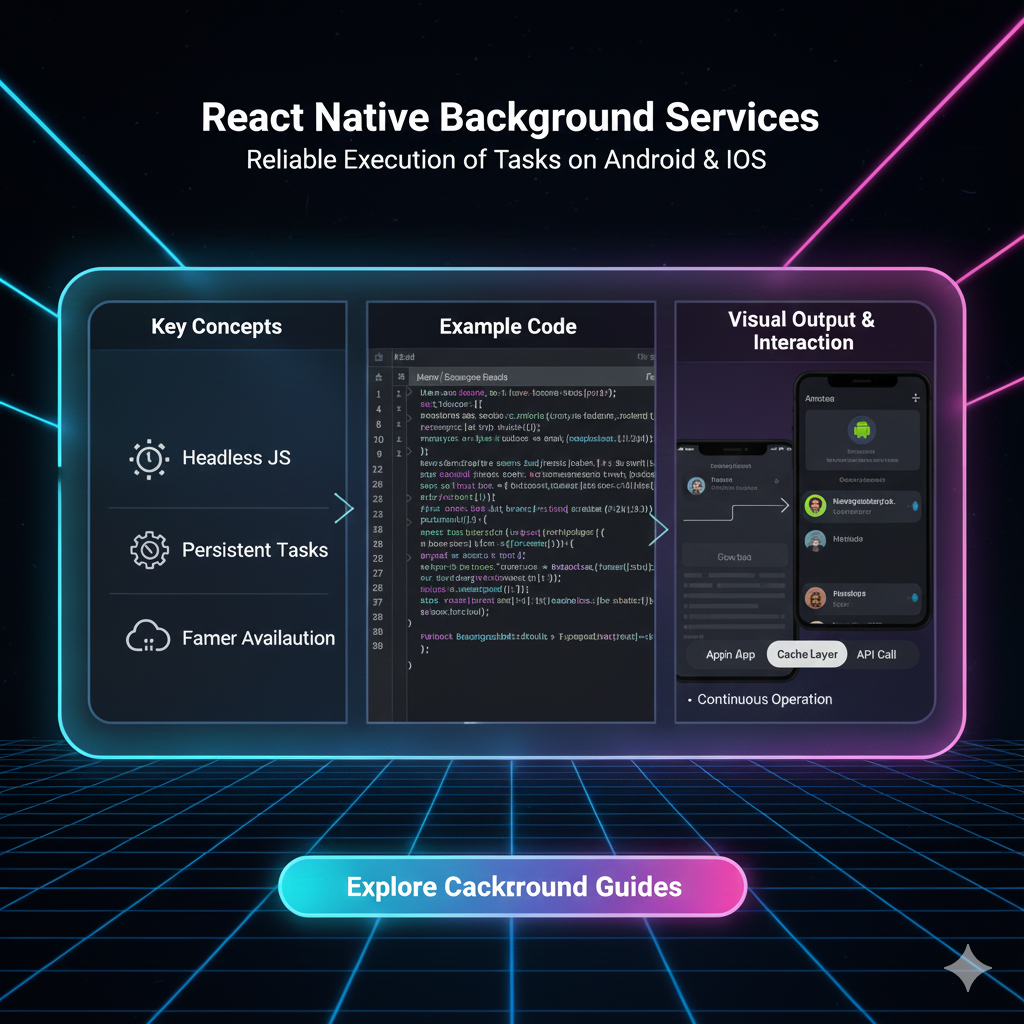
Tired of your React Native app dying in the background? Learn how to use Headless JS, background tasks, and native modules for music, location, and more. Level up your skills at codercrafter.in!
Alright, let's talk about a problem every React Native developer hits eventually. You've built this awesome app. Maybe it plays music, tracks a user's morning run, or syncs data periodically. It works perfectly... until the user presses the home button or switches to another app.
Suddenly, your JavaScript logic just... stops. The music cuts out. The run tracker freezes. Your app is effectively napping, and the user is left frustrated.
Sound familiar?
This is the classic challenge of background execution in mobile development. Unlike a server that runs 24/7, mobile operating systems (iOS and Android) are ruthlessly efficient. They aggressively manage resources, putting apps in the background to sleep to save battery life and keep the device running smoothly.
So, how do we build apps that need to keep working even when they're not in the foreground? The answer lies in React Native Background Services.
In this no-fluff guide, we're diving deep into what background services are, the different ways you can implement them (from the simple to the powerful), real-world use cases, and the critical best practices you need to know. Let's get your app working overtime.
What Are Background Services, Really?
In simple terms, a background service is a piece of your app's code that continues to run even after the user has navigated away from the app. It's your app's way of saying, "I'm not done yet, I've got more to do!"
Think of it like this:
Foreground: The app is open on the screen. The user is actively tapping and scrolling. This is full-power mode.
Background: The app is still "running" in memory, but it's not what the user sees. The user pressed the home button or got a notification. The OS can suspend it at any time.
Background Service: A specific task (like playing audio or tracking location) that the OS explicitly allows to continue, even when the app is in the background or even terminated.
It's crucial to understand that you can't just run any JavaScript you want forever in the background. Both iOS and Android have strict rules about what's allowed, for how long, and under what conditions.
Your Toolkit for Background Tasks in React Native
There are several ways to tackle background work in React Native, each with its own strengths and limitations.
1. The Built-in (But Limited) Option: AppState & setTimeout
For very simple, short-lived tasks, you can use React Native's AppState to know when your app goes to the background and then try to squeeze in some work.
javascript
import { AppState } from 'react-native';

// ... inside your component
useEffect(() => {
  const subscription = AppState.addEventListener('change', nextAppState => {
    if (nextAppState === 'background') {
      // We just went to the background. Let's try to do something quickly!
      // WARNING: This is not guaranteed to finish.
      syncDataToServer();
    }
  });

  return () => {
    subscription.remove();
  };
}, []);
The Catch: This is incredibly unreliable. The OS can suspend or terminate your app before your syncDataToServer function finishes. This method is best for saving a small piece of state locally, not for any meaningful, long-running work.
2. The JavaScript-Only Hero: react-native-background-timer
This community library tries to solve the problem by providing a timer that isn't killed when the app backgrounds. It's useful for tasks that need to run at regular intervals, like polling an API every few minutes.
javascript
import BackgroundTimer from 'react-native-background-timer';

// Start a periodic task
const intervalId = BackgroundTimer.setInterval(() => {
  // This will run every 5 seconds, even in the background.
  checkForNewMessages();
}, 5000);

// Don't forget to clear it!
// BackgroundTimer.clearInterval(intervalId);
The Catch: On iOS, this often requires the app to have a background mode like Audio or Location to work reliably. It's a JavaScript-level solution that's still at the mercy of the OS's process management.
3. The Android Powerhouse: Headless JS
This is a cool, React Native-specific feature for Android. A "Headless JS" task allows you to run JavaScript code in a dedicated context after the app has been closed (terminated), usually triggered by a native module (like a push notification or a system broadcast).
It's called "headless" because it runs without a UI.
The Catch: It's Android-only. iOS has a similar concept with "Background Fetch," but the implementation is different.
4. The Ultimate Solution: Native Modules
When you need reliability and full access to platform-specific background APIs, you have to go native. This involves writing Java/Kotlin code for Android and Objective-C/Swift code for iOS to create a true background service (Android) or background NSOperation/URLSession (iOS).
This is the most powerful approach and is used by all the major libraries for critical tasks like:
Audio playback (
react-native-track-player)Location tracking (
react-native-geolocation-service)Push notifications (
react-native-push-notification)File downloads (
react-native-background-downloader)
The good news? You often don't need to write this native code yourself. You can leverage these battle-tested libraries that have already done the hard work.
Real-World Use Cases: Where You Actually Need This
This isn't just theoretical. You've used apps that rely on this every day.
Music & Podcast Apps (Spotify, Pocket Casts): Uses the
audiobackground mode to keep playing music.Fitness & Navigation Apps (Strava, Google Maps): Uses the
locationbackground mode to continuously track your route.Messaging Apps (WhatsApp, Telegram): Use push notifications to wake the app up and sync new messages in the background.
File Download Managers: Use a native background service to download large files even when the app is closed.
Data Sync Apps: Periodically fetch new data from the server to have it ready when the user opens the app again.
Best Practices: Don't Be a Battery Hog
With great power comes great responsibility. Misusing background services is the fastest way to get your app uninstalled and get negative reviews for "draining battery."
Ask for Permission: Always request user permission for sensitive background modes like location. Explain why you need it.
Be Efficient: For location tracking, use the appropriate accuracy. Don't use GPS-level accuracy if you only need a rough estimate. Use batching and distance filters.
Stop When Done: Your service should have a clear end condition. Stop the location tracker when the run is finished. Pause the audio service when the playlist ends.
Leverage the OS: Use Push Notifications to wake your app up for new data instead of constantly polling the server every few minutes. This is far more battery-efficient.
Test, Test, Test: Background behavior is one of the trickiest things to debug. Test on real devices, not just simulators. Test with the app in the foreground, background, and terminated states.
FAQs
Q: Can I run any task indefinitely in the background?
A: Absolutely not. Both iOS and Android will eventually terminate your task to preserve battery and system resources. You must design your tasks to be completable.
Q: Why is background processing so much stricter on iOS than Android?
A: Apple places a very high priority on user privacy and battery life, leading to a more restrictive and controlled environment. Android offers more flexibility but still enforces strict rules, especially in newer versions.
Q: My background task works on Android but not iOS. Why?
A: This is the most common issue. You are likely using a method that isn't supported by iOS's declared background capabilities. You need to ensure you've enabled the required background mode in your Xcode project and are using a library that properly implements the native iOS side.
Q: What's the easiest way to get started with a reliable background task?
A: Don't reinvent the wheel. For a specific task like audio or location, use a well-maintained library like react-native-track-player or react-native-geolocation-service. They handle the complex native implementation for you.
Conclusion: Background Work is a Pillar of Modern Apps
Mastering background services is what separates a good mobile app from a great one. It's about providing a seamless, uninterrupted user experience that feels reliable and professional. While it's one of the more challenging areas of React Native development, understanding the tools and best practices is essential.
Start with the simple solutions like react-native-background-timer for basic needs, and don't be afraid to leverage powerful native-module-based libraries for the heavy lifting. Always remember to be a good citizen on the user's device—efficiency is key.
Feeling inspired to build powerful, professional-grade React Native applications that work flawlessly, both in the foreground and the background? This is just the tip of the iceberg.
To learn professional software development courses such as Python Programming, Full Stack Development, and the MERN Stack, visit and enroll today at codercrafter.in. Our project-based curriculum is designed to take you from fundamentals to advanced concepts like these, ensuring you build the skills that the tech industry demands.