Offline-First App Architecture: Build Unbreakable Mobile Apps
Tired of spinning wheels? Master offline-first app architecture. Learn how top apps like WhatsApp stay reliable, with strategies for sync, conflict resolution, and tools. Build better apps.
Picture this: you're on the subway, deep in a tunnel, trying to finalize a shopping list or send a quick message. You tap the button, and... nothing. Just a frozen screen and a spinning wheel of doom. We've all been there, and honestly, it's infuriating. You might be surprised to learn that the apps that don't fail you in that moment—like your messaging app or note-taking tool—are likely built with a powerful design philosophy called offline-first architecture.
An offline-first app is designed to perform all, or at least its most critical functions, without needing an internet connection . Think of it like your phone's notes app: you can jot down ideas, edit, and save them whether you're on WiFi, mobile data, or sitting on a plane in airplane mode. The magic is that it stores your data locally on your device first. When a connection becomes available, it automatically syncs everything in the background .
Why does this matter now more than ever? Because user patience is thinner than ever. Studies show that over 70% of mobile app users will abandon an app that takes too long to load, and 84% will give up if it fails just twice . In our world of spotty coverage, underground commutes, and remote work, assuming everyone has perfect, permanent connectivity is a recipe for a frustrating app that gets deleted. Offline-first isn't just a fancy feature for niche scenarios; it's becoming the gold standard for creating resilient, reliable, and user-friendly applications .
Why Offline-First? More Than Just a "Nice-to-Have"
The push towards offline-first is driven by real-world demands for reliability and performance. It flips the traditional "online-first" script. Instead of your app being a mere window to a distant server, it becomes a powerful, self-sufficient tool on your device.
User Expectations Have Changed: We expect apps to work instantly, anywhere. Whether you're a field technician in a rural area, a doctor in a busy hospital with thick walls, or just someone going through a tunnel, waiting for a connection isn't acceptable .
It's a Performance Powerhouse: Since data is read from the local device storage (like SQLite or Realm), operations feel lightning-fast. There's no waiting for a round-trip to a server, which makes your app feel incredibly snappy and responsive .
Uninterrupted Business Operations: For enterprises, this is a game-changer. Logistics companies can track deliveries in dead zones, retail stores can process sales during internet outages, and construction teams can file reports from remote sites. Workflows don't halt just because the network does .
To truly grasp the difference, consider how these two architectures approach a simple task:
flowchart LR
    subgraph Online_First
        direction LR
        OF_Start[User Action] --> OF_Check{Online?}
        OF_Check -- Yes --> OF_Send[Request Sent to Server] --> OF_Wait[Wait for Response] --> OF_Update[UI Updates]
        OF_Check -- No --> OF_Fail[Show Error / Spinner]
    end

    subgraph Offline_First
        direction LR
        OFF_Start[User Action] --> OFF_Save[Save to Local DB] --> OFF_UI[UI Updates Instantly]
        OFF_Save --> OFF_Queue[Queue for Sync]
        OFF_Queue --> OFF_Sync[Sync to Server when Online]
    end
The Nuts and Bolts: How Offline-First Architecture Actually Works
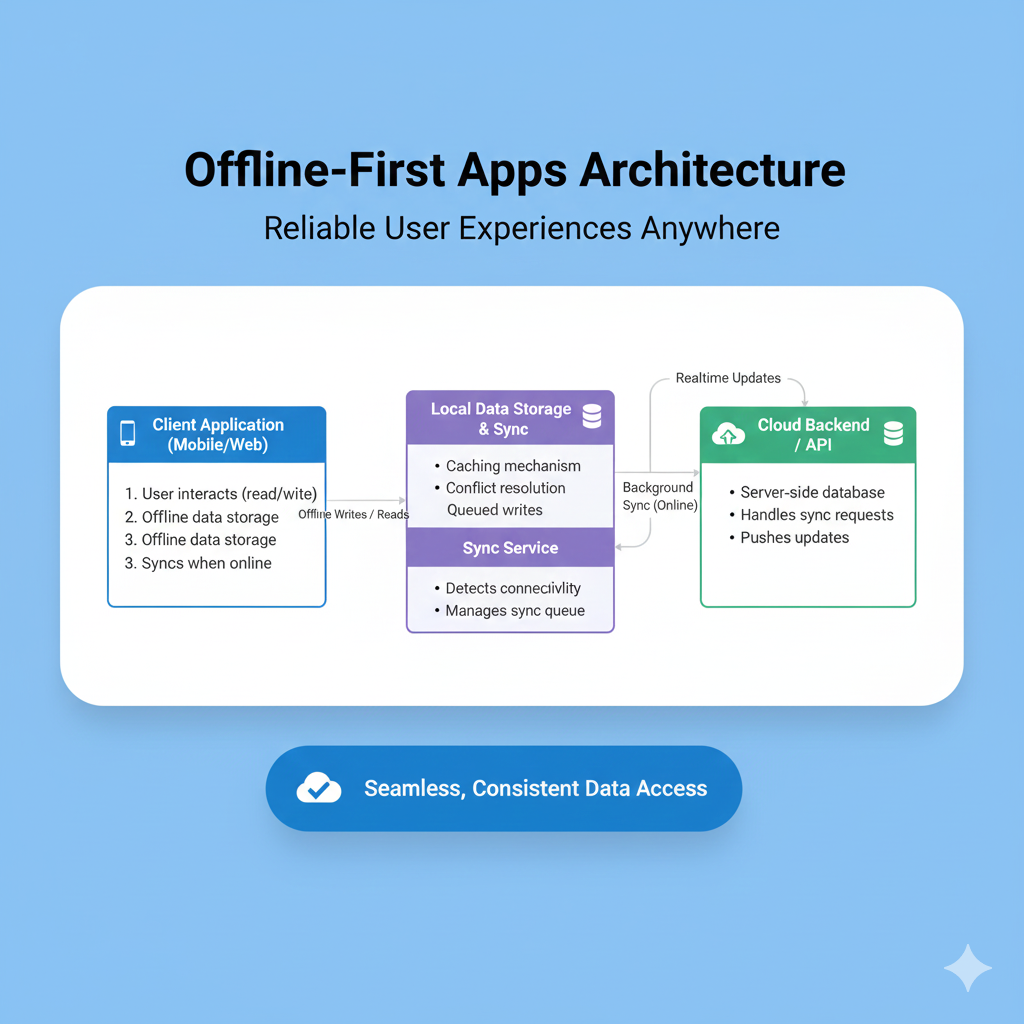
Building an offline-first app requires a fundamental shift in how you structure your app's data layer. Instead of your app talking directly to a network API, it treats a local database as its single, primary source of truth .
Core Architectural Components
Local Data Source: This is the heart of the app. It's typically a database on the device (like Room on Android, Core Data on iOS, or SQLite/Realm cross-platform). Every piece of data your app needs to function is stored here first. The UI only reads from this source, ensuring consistency whether you're online or offline .
Network Data Source: This is your traditional backend server or API. Its role changes: instead of being the primary source, it becomes a synchronization partner for the local database .
Repository Pattern: This is the intelligent manager that sits between the local and network sources. It decides when to read from the local cache, when to fetch new data from the network, and how to queue up changes made offline to be sent later .
Sync Engine & Conflict Resolution: This is the secret sauce. When the app comes back online, the sync engine pushes local changes to the server and pulls down any updates. If the same data was edited in two places, a conflict resolution strategy (like "last write wins" or more complex merging logic) is needed to decide the final truth .
Handling Reads and Writes: The Developer's Playbook
Reading Data: The app always reads from the local database first. This is often done using observable data streams (like
FloworLiveDatain Android, orStreamin Flutter). This means the UI updates immediately with cached data. The repository can then optionally fetch fresh data from the network and update the local database, which automatically pushes new data to the UI .Writing Data: When a user takes an action (e.g., saves a note), that data is written directly to the local database, and the UI confirms the action instantly—this is called an optimistic UI. The write operation is also placed in a synchronization queue. A background worker (like WorkManager on Android) handles sending these queued writes to the server whenever connectivity is restored .
Real-World Magic: Apps You Use Every Day
This isn't just theoretical. Some of the world's most beloved and reliable apps are built this way:
WhatsApp: Its entire chat history is stored on your phone. You can read, search, and compose messages completely offline. They are queued and sent the moment you're back online .
Google Maps: You can download entire city maps for offline use, allowing for navigation without a data connection.
Figma & Linear: These cutting-edge collaboration tools use sophisticated data structures (CRDTs) to allow multiple users to edit complex documents offline, seamlessly merging everyone's changes when they sync .
Spotify & Netflix: By downloading playlists and shows, these media apps provide uninterrupted entertainment anywhere.
Navigating the Challenges: Sync, Conflicts, and Storage
Of course, this power comes with new complexities that developers must tackle:
Data Synchronization: Building a robust, efficient, and battery-friendly sync mechanism is hard. You need to track changes, handle retries, and sync only what's changed (delta sync) .
Conflict Resolution: What happens if a customer updates their address on their phone offline, while a support agent simultaneously updates it on the web portal? You need clear rules—like timestamp-based "last write wins," manual merge flags, or advanced Conflict-Free Replicated Data Types (CRDTs)—to resolve these disputes automatically .
Security: Storing data locally means you must encrypt sensitive information on the device to keep it safe .
Testing: You must rigorously test a myriad of states: offline creation, online editing, prolonged offline periods, and sync recovery scenarios.
Getting Started: Tools of the Trade
Thankfully, you don't have to build everything from scratch. A strong ecosystem of tools and frameworks can help:
Local Databases: SQLite is the ubiquitous workhorse. Room (Android) and Core Data (iOS) are powerful abstractions over it. For more sync-focused needs, Realm, Couchbase Lite, and WatermelonDB are excellent choices .
Sync Solutions: Firebase Firestore, AWS AppSync, and Couchbase Capella offer managed backend services with built-in, real-time sync capabilities .
Background Processing: Use WorkManager (Android) or Background Tasks (iOS) to manage reliable background sync jobs .
Your Offline-First FAQs Answered
Q: Does offline-first mean my app never needs the internet?
A: Not necessarily. It means core functionality works offline. Syncing, fetching fresh social feeds, or streaming video will still require a connection, but the app's primary tasks shouldn't be blocked by it .
Q: Isn't this overly complex for a simple app?
A: It adds initial architectural complexity, but for many apps, the long-term payoff in user satisfaction, retention, and reliability is immense. For very simple, always-online tools, a traditional approach might suffice .
Q: How do I handle data that's too large to store locally?
A: Use smart caching strategies. Store only the essential data the user needs (e.g., recent documents, not the entire archive). Implement features like on-demand downloading for less-critical bulk data.
Q: When should I not use offline-first?
A: If your app's entire value is in real-time, streaming data (like a live sports ticker or a stock trading platform where milliseconds count), an online-first architecture with heavy caching might be more appropriate .
Conclusion: Building for the Real World
Offline-first architecture is more than a technical pattern; it's a declaration of respect for your users' reality. It acknowledges that connectivity is fragile and that people's time and attention are precious. By prioritizing local functionality, you build apps that are faster, more reliable, and ultimately, more indispensable.
The transition requires thoughtful design around data modeling, synchronization, and conflict resolution. However, the result is an application that feels solid, professional, and trustworthy—qualities that users not only appreciate but have come to demand.
To learn how to architect modern, resilient applications like these and master in-demand development skills, explore professional software development courses such as Python Programming, Full Stack Development, and MERN Stack at codercrafter.in. Visit and enroll today to build the next generation of user-centric software.