Tired of complex backend code? Discover how Backendless, a visual no-code backend platform, can power your apps. Learn its features, real use cases, best practices & FAQs. Want to go deeper? Learn professional dev courses at codercrafter.in.
Ditching the Server Drama: Building Your App's Brain with Backendless (No Coding Needed)
Let's be real. The word "backend" sounds intimidating. It conjures images of complex servers, cryptic terminal commands, databases that look like spreadsheet nightmares, and the constant fear of your app crashing because you missed a semicolon. For founders, indie developers, UX designers with a killer app idea, or even full-stack devs who just want to move faster, the backend has always been the annoying, time-sucking bottleneck.
But what if you could build the logic, database, and features of your app… without actually writing backend code? Enter the world of no-code backends, and specifically, a powerful platform called Backendless. This isn't about making a simple form; it's about building the actual, scalable engine for your application.
In this deep dive, we’re going to strip away the jargon and look at how tools like Backendless are changing the game. Whether you're a non-technical creator or a seasoned dev looking for a turbo boost, this is for you.
What on Earth is a "No-Code Backend"?
Okay, let's break it down. Your app has two main parts:
The Frontend: The pretty (or hopefully pretty) interface users see and touch. Built with HTML, CSS, JavaScript, React, Flutter, etc.
The Backend: The brain behind the scenes. It stores user data, runs calculations, sends notifications, processes payments—all the magic that happens off-screen.
Traditionally, building this brain required languages like Python, Node.js, or Java, plus databases like PostgreSQL, and hosting on services like AWS. It's a whole career path (a lucrative one!).
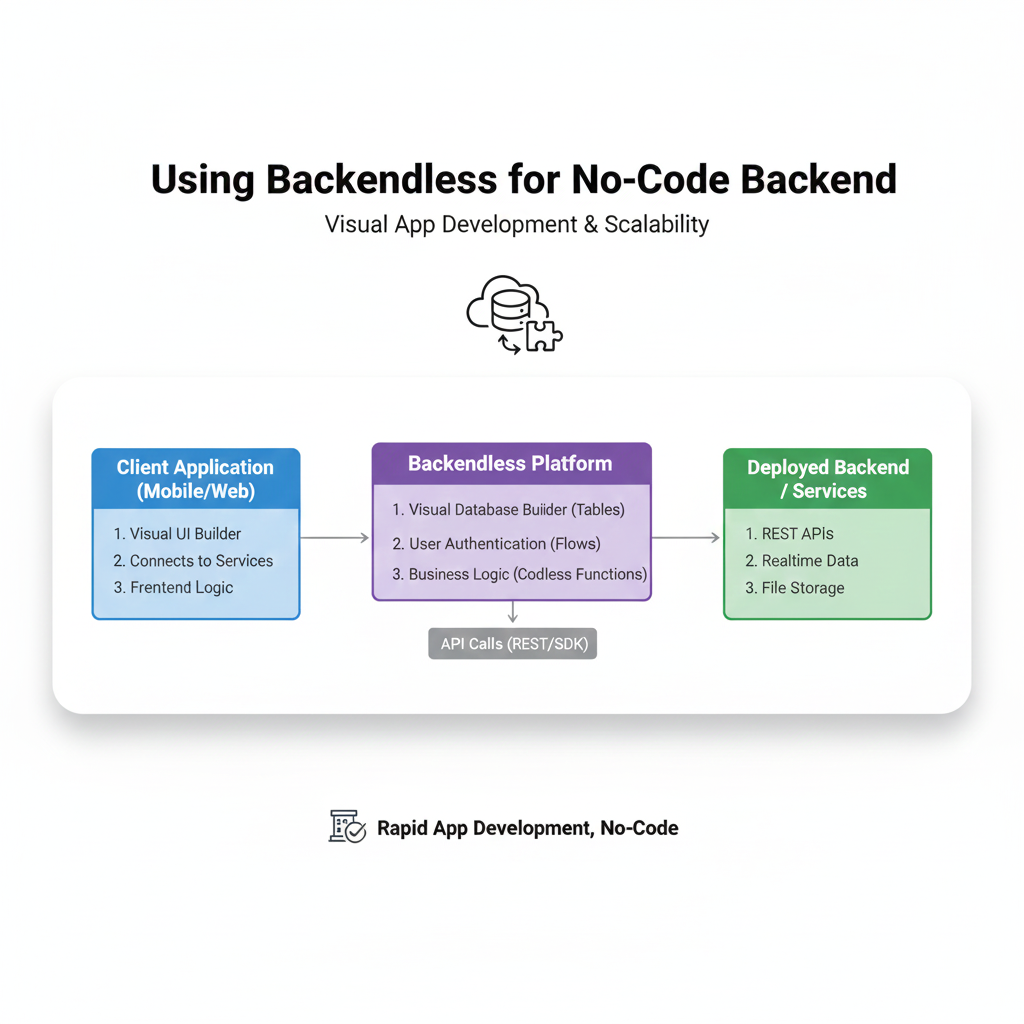
A No-Code Backend is a visual platform that gives you all those brain components—databases, user authentication, file storage, APIs, server logic—through a drag-and-drop, menu-driven interface. You configure instead of code.
Think of it like this: Before, you had to manually build a car engine from scratch. Now, you're given a fully assembled, customizable engine block. You just plug in the parts you need (fuel injection, turbo) using standardized connectors.
Why Backendless Stands Out in the Crowd
While there are several players (like Firebase, Supabase with its low-code angle), Backendless is often called the "Swiss Army knife" of no-code backends. Here’s why it gets attention:
It’s a Full Stack in One Box: Database, user management, real-time messaging, push notifications, geolocation, video/audio streaming, and even a built-in hosting option for your frontend files. You don't need to juggle ten different services.
The Visual "Codeless" Logic Builder: This is the killer feature. You can create complex business logic using a visual workflow editor—dragging boxes for "if/then" conditions, database operations, and API calls. It turns abstract logic into a flowchart anyone can understand.
True API-First: Everything you build visually is automatically turned into a clean, documented REST API. Your custom frontend (React, iOS, Android) or even other tools can talk to it seamlessly.
On-Premise Option: For enterprises with strict data privacy needs, you can host Backendless on your own servers. That's a huge deal for healthcare or finance apps.
Real-World Stuff You Can Actually Build
Enough theory. What can you make?
A Social Community App (like a niche Instagram):
Database: Visual tables for
Users,Posts,Comments,Likes.Authentication: Full sign-up/login flows with email, social logins (Google, Facebook).
Logic: A visual workflow that triggers whenever a new
Commentis added: "Notify the post owner via email" and "Update the comment count on the post."Real-Time: Live feeds where new posts appear without refreshing.
File Storage: Users upload profile pics and post images directly to Backendless Cloud.
An On-Demand Delivery Dashboard (like a local food delivery):
Database:
Customers,Drivers,Orders,Restaurants.Logic: A workflow triggered on
Ordercreation: "Find available drivers within 3 miles of the restaurant (geolocation)," "Send a push notification to the nearest driver," "If no one accepts in 5 minutes, expand the search radius."Live Tracking: Use real-time capabilities to show the driver's moving location on a map for the customer.
An Internal Business Tool (like a CRM or Task Manager):
This is where it shines for non-technical teams. The marketing team can design the data they need to track (Leads, Campaigns), and use the visual builder to automate follow-up email reminders or create reports—all without ever filing a ticket for the dev team.
Best Practices: Making the Most of Backendless
Jumping in headfirst can lead to a messy setup. Here’s how the pros do it:
Plan Your Data Structure First: Sketch your database tables (they call them "Data Tables") and relationships on paper or a whiteboard before building. Clear structure is key.
Use the "Codeless" Feature for Business Logic, Not for Everything: It's powerful, but for extremely simple operations (like just saving data), sometimes using the direct API is cleaner. Use the visual logic for multi-step processes.
Secure Your API Keys & Permissions: Backendless has robust role-based permissions. Don't just give "public" create/write access to your main database. Define roles (User, Admin, Anonymous) and set permissions meticulously.
Test Your Visual Logic Thoroughly: The workflows have debugging tools. Use them. Test with different data inputs to make sure your "if/then" branches work correctly.
Document Your API: Since Backendless auto-generates your API, make a simple document for your frontend team (or your future self) listing the key endpoints.
FAQs - Your Burning Questions, Answered
Q: Is this only for prototyping? Can it scale?
A: This is the biggest myth. Backendless is built on scalable cloud infrastructure (AWS, Google Cloud). It's used by startups and enterprises with thousands of users. The "no-code" part is about your interaction, not its underlying power.
Q: Won't I get "locked in"?
A: Some vendor lock-in exists, as with any Platform-as-a-Service. However, Backendless mitigates this by using standard SQL databases (you can export your data) and generating standard REST APIs. Your frontend remains completely independent.
Q: As a developer, should I feel threatened by this?
A: Absolutely not. Think of it as a powerful new tool in your belt. It automates the repetitive, boilerplate parts of backend development (CRUD APIs, auth setup). This frees you up to focus on the unique, complex problems that truly require your custom code and expertise. It's a productivity multiplier, not a replacement.
Q: What's the catch? Cost?
A: There's a very generous free tier for learning and small projects. Paid tiers scale with usage (number of API calls, database records, file storage). It's crucial to estimate your app's growth and choose a plan accordingly. It's often still far cheaper than hiring a full backend team.
Conclusion: The Future is Visual (At Least Part of It)
Backendless and platforms like it aren't a fad. They represent a fundamental shift: abstracting away infrastructure complexity so creators can focus on functionality and user experience. It democratizes app development.
For the solo entrepreneur, it means going from idea to MVP in weeks, not months. For the small business, it means building custom tools without a massive tech budget. For the professional developer, it's a secret weapon for rapid prototyping, building internal tools, or managing backend microservices.
The bottom line? You don't always need to build the engine from scratch. Sometimes, you just need to know how to drive—and how to tune it for maximum performance.
Ready to transition from configuring to true, deep creation? While no-code tools are fantastic, understanding the core principles of software engineering gives you unparalleled power and flexibility. To learn professional software development courses such as Python Programming, Full Stack Development, and MERN Stack, visit and enroll today at codercrafter.in. Master the fundamentals and you'll be able to not only use tools like Backendless but also understand exactly what they're doing under the hood, and even build your own solutions when needed.