Cash In Your Code: Top React Native Monetization Strategies for 2025
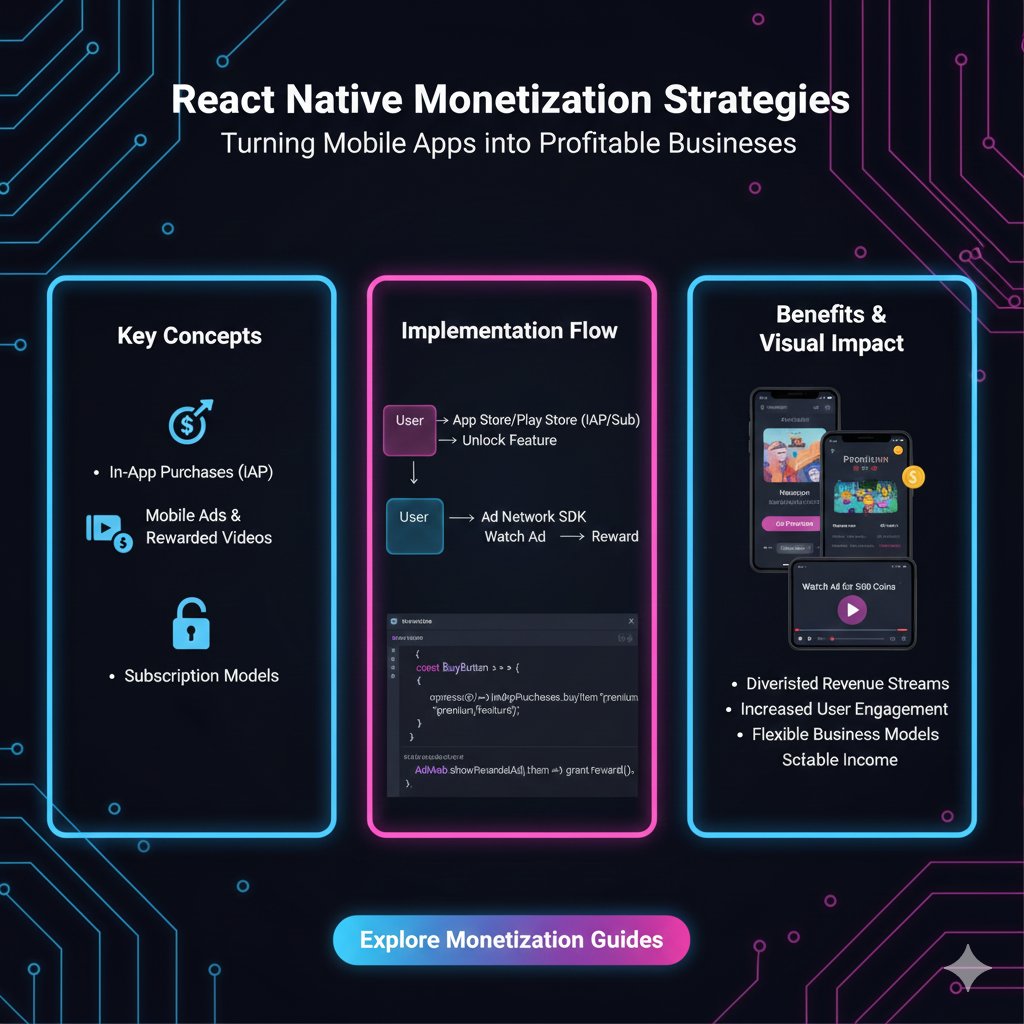
Built an amazing React Native app? Now, learn how to make money from it! Explore in-app purchases, subscriptions, ads, freemium models & more. Turn your code into cash flow.
Cash In Your Code: Your Ultimate Guide to React Native Monetization in 2025
So, you’ve done the hard part. You’ve spent countless nights, fueled by coffee and a grand vision, to build a killer React Native app. It’s sleek, it’s functional, and users are starting to trickle in. Awesome! But now comes the million-dollar question (literally): How do you actually make money from this thing?
Let’s be real, passion projects are cool, but sustainability is cooler. Monetizing your app isn't just about slapping on some ads and calling it a day. It's a strategic game. Picking the right model can be the difference between an app that fizzles out and one that becomes a steady revenue stream, or even your full-time gig.
In this deep dive, we’re breaking down the most effective React Native monetization strategies that real companies are using right now. We’ll go beyond the definitions and look at the real-world how, the why, and the "oh, I didn't think of that."
1. Freemium Model: The "Try Before You Fly" Classic
What it is: You offer a solid, fully-functional app for free, but lock the really powerful or sexy features behind a paywall. This is arguably the king of mobile monetization for a reason.
How it Works in React Native: You build your app with both free and premium tiers. Using state management (like Redux or Context) and backend checks, you control feature access. When a user upgrades, you unlock those premium components.
Real-World Example: Spotify. The free version is great, but who wants ads and no offline listening? The premium upgrade is a no-brainer for music lovers.
React Native Tech Stack: You can use libraries like
react-native-iap(In-App Purchases) to handle subscriptions and one-time purchases seamlessly for both iOS and Android.
Best For: Productivity apps, creative tools, music/audio platforms, and any app where advanced features provide clear, tangible value.
2. In-App Advertising: The "Earn While They Engage" Powerhouse
This is the most common model, but it's also the one you have to handle with care. Nobody likes a spammy app.
What it is: You display ads within your app and get paid based on views (CPM) or clicks (CPC).
Popular Ad Formats in React Native:
Banner Ads: The small, rectangular ads at the top or bottom of the screen. They're low-intrusion but also have lower payouts.
Interstitial Ads: The full-screen ads that pop up at natural transition points, like between game levels or after completing a task. These have higher engagement and pay better.
Rewarded Videos: This is the win-win. Users choose to watch a short ad in exchange for an in-app reward—like extra lives in a game, a power-up, or bypassing a timer. User gets a benefit, you get paid. Everyone's happy.
How to Implement: Integrate an ad network SDK. The big players are:
Google AdMob: The giant. Great for both iOS and Android. Libraries like
react-native-google-mobile-adsmake integration manageable.Facebook Audience Network: Leverages Facebook's massive advertiser base. Good for targeted ads.
Unity Ads: Absolutely fantastic for gaming apps. Their rewarded video integration is top-notch.
Pro Tip: The key here is placement, placement, placement. Don't interrupt a user's primary task. Place ads where they make sense and feel natural, not annoying.
3. Subscriptions: The "Recurring Revenue Dream"
If you can pull this off, it’s the holy grail. Instead of a one-time payment, users pay weekly, monthly, or yearly for ongoing access.
What it is: Recurring payments for continued access to content, services, or premium features.
How it Works in React Native: Again, react-native-iap is your best friend here. You set up subscription tiers on the Apple App Store and Google Play Console, and the library handles the purchase flow. Your backend then verifies the receipt and grants access.
Real-World Example: YouTube Premium. No ads, background play, and offline downloads for a monthly fee. A classic content-based subscription.
Another Example: Calm or Headspace. They provide a constant stream of new meditations and sleep stories, making a subscription the logical model.
Best For: Apps with regularly updated content (news, podcasts, video), software-as-a-service (SaaS) tools, and wellness/learning platforms.
4. In-App Purchases (IAP): The "Micro-Transaction Magic"
Often confused with subscriptions, IAPs are typically one-time purchases for digital goods within the app.
What it is: Users spend real money to buy virtual goods. This is massive in the gaming world but applies elsewhere too.
Types of IAPs:
Consumables: Things that can be used up and repurchased (e.g., coins, gems, extra lives).
Non-Consumables: Permanent unlocks (e.g., removing ads forever, buying a special filter pack, unlocking a pro camera feature).
Auto-Renewable Subscriptions: (We covered this above!).
Real-World Example: Candy Crush Saga. Buying more lives or boosters is the textbook example of a consumable IAP. VSCO, the photo-editing app, sells preset filter packs as non-consumable IAPs.
5. Sponsorships & Partnerships: The "Influencer Model for Apps"
This is a more creative, high-touch approach.
What it is: Partnering with a brand that aligns with your app's audience. They pay you to integrate their product, service, or message into your app in an organic way.
How it Could Work:
A fitness app could partner with a healthy meal-kit company.
A book-reading app could have a sponsored "Book of the Month" from a publisher.
A coding tutorial app (wink, wink) could partner with a tech company for a dedicated learning path.
This requires a sizable and engaged user base, but the payouts can be significant and the integration feels much more native than a generic ad.
6. Affiliate Marketing: The "Earn a Cut" Strategy
What it is: You promote other companies' products or services within your app. When a user makes a purchase through your unique link, you earn a commission.
Real-World Use Case: Imagine you have a travel app built with React Native. You could integrate affiliate links for booking.com or Airbnb. When a user books a hotel through your app, you get a percentage. It’s a great way to monetize without directly charging your users.
Best Practices: Don't Just Monetize, Monetize Right
Know Your Audience: A model that works for a hardcore gaming app will fail miserably for a meditation app. Understand what your users will tolerate and what provides them value.
Value First, Money Second: Your free tier or ad-supported version must be genuinely useful. If it's just a crippled demo, no one will stick around to pay.
UX is King: However you monetize, it should not ruin the user experience. Intrusive ads or confusing paywalls will drive users away faster than you can say "uninstall."
Test and Iterate: Use A/B testing to try different ad placements, subscription prices, or premium features. Data beats gut feeling every time.
Consider a Hybrid Model: The most successful apps often mix and match. A freemium app might show a few non-intrusive banners in its free version. A subscription app might still offer one-off IAPs for special content.
FAQs: Quick Fire Round
Q: Is react-native-iap the only library for payments?
A: It's the most popular and well-maintained for handling App Store and Play Store payments. For direct credit card payments (e.g., for a web service linked to your app), you'd use something like Stripe (react-native-stripe).
Q: What's the easiest model to start with?
A: For a new app, starting with a simple Freemium model (with a one-time payment to unlock pro features) or Rewarded Videos (if it fits your app) is a great, low-risk way to test the waters.
Q: How do Apple and Google affect my revenue?
A: Crucially! Both take a 15-30% cut of all digital goods and subscriptions sold through their stores. Factor this into your pricing strategy.
Q: Can I use multiple models at once?
A: Absolutely! Just be careful not to overdo it. A common combo is Freemium + Non-Intrusive Ads in the free version.
Conclusion: Your App, Your Business
Monetizing your React Native app isn't a one-size-fits-all formula. It's a strategic choice that hinges on your app's purpose, your target audience, and the value you provide. Whether you go with the steady drip of subscriptions, the targeted approach of ads, or the direct value of in-app purchases, the goal is to build a sustainable business that allows you to keep doing what you love: building amazing things.
The technical implementation of these strategies—integrating payment gateways, managing user state, and building scalable backend checks—is where solid software development skills truly pay off.
Ready to build the next generation of monetizable, world-class applications? To learn professional software development courses such as Python Programming, Full Stack Development, and the MERN Stack, visit and enroll today at codercrafter.in. We'll give you the tools to not just code, but to build a career.
Now go out there and cash in your code!