Context API vs Redux vs Zustand: The 2025 State Management Showdown (Real Talk)
Stuck choosing a state manager for React? We break down Context API, Redux, and Zustand with code, real use-cases, and no fluff. Find your perfect fit and build better apps. Level up your skills with professional courses at CoderCrafter.in.
Let’s be real. If you’re building anything beyond a todo list in React, you’ve hit the state management wall. Props drilling feels like passing notes through a row of uninterested classmates, and your component tree starts looking messy. You Google "React state management," and bam—you’re hit with a dozen options, heated Twitter threads, and enough jargon to make your head spin.
Relax. We’ve all been there. The three names that always pop up are Context API, Redux, and Zustand. But which one is right for your project? Is Redux still the king, or is it overkill? Is Context API enough? What the heck is a Zustand?
This isn’t just another tech comparison. We’re going to break these tools down in plain English, with code you can actually understand, real-world use cases, and zero unnecessary hype. By the end, you’ll know exactly which tool to reach for.
The Core Problem: Why Do We Even Need These Tools?
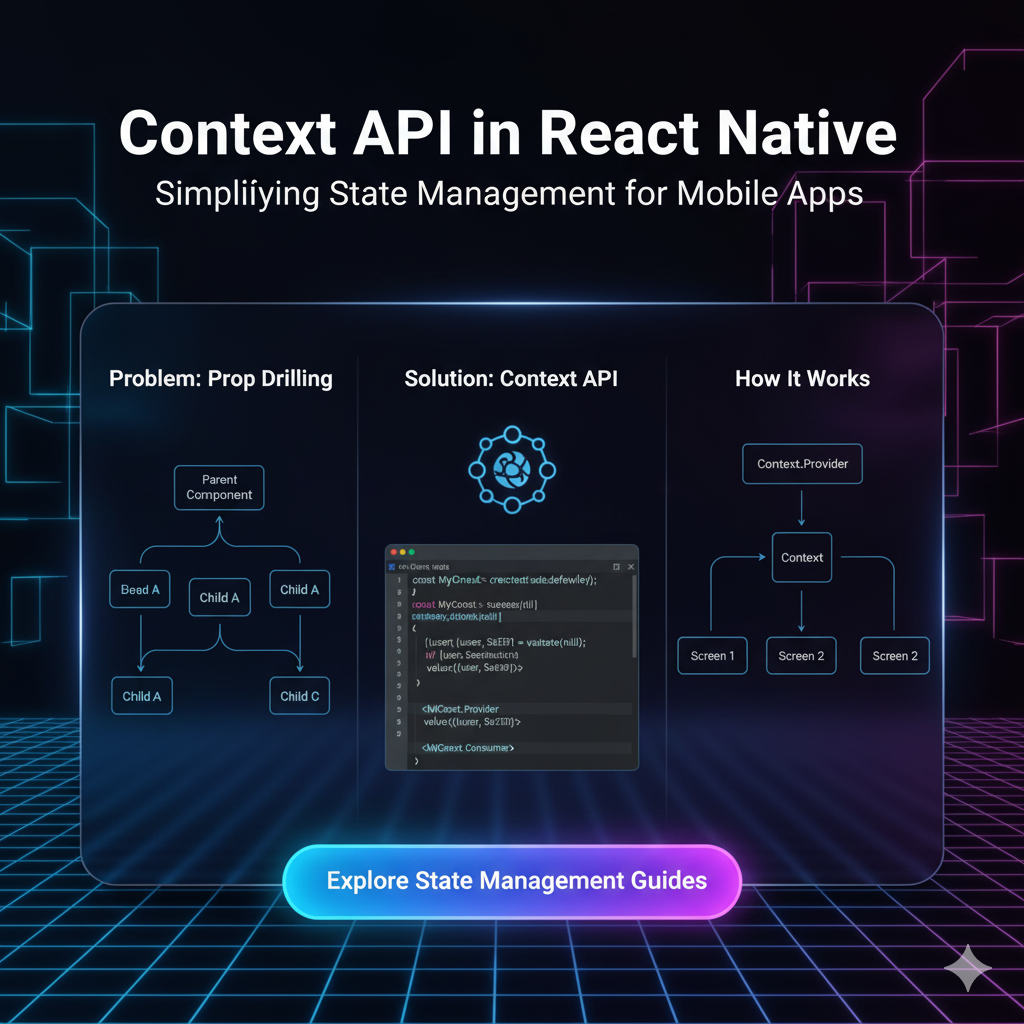
Imagine your app is a music festival. Your user profile (name, avatar) is info needed at the entrance (Navbar), the food court (UserSettings), and the merch store (Dashboard). Carrying a physical copy (prop) and handing it through every security check (component) between the entrance and the store is… inefficient. You need a central info booth.
That’s what state management does. It creates a central “info booth” (global store) that any part of your app (component) can access directly, no middlemen required.
1. Context API: The Built-in Solution
What is it?
Think of Context API as React’s official, lightweight tool for passing data down the component tree without manually passing props at every level. It’s not a full-blown state management library per se, but a propagation mechanism.
How it Works (The Vibe):
You create a “Context” (like a radio frequency). You wrap part of your app in a Provider (the radio transmitter) that holds the data. Any component within that wrapper can tune into that frequency using useContext (the receiver) and get the data.
Simple Code Example: Theme Switcher
javascript
// 1. Create the Context
const ThemeContext = createContext();

// 2. Create the Provider (wraps your app)
function App() {
  const [theme, setTheme] = useState('light');
  return (
    <ThemeContext.Provider value={{ theme, setTheme }}>
      <Header />
      <Main />
    </ThemeContext.Provider>
  );
}

// 3. Use the Context in any child
function Header() {
  const { theme, setTheme } = useContext(ThemeContext);
  return (
    <header className={theme}>
      <button onClick={() => setTheme(theme === 'light' ? 'dark' : 'light')}>
        Toggle Theme
      </button>
    </header>
  );
}
Real-World Use Case:
Perfect for truly global, low-frequency updates: Theme, authenticated user object, UI language (i18n), or maybe a global loading spinner. Stuff that doesn’t change 60 times a second.
The Catch (The Fine Print):
Re-render Hell: If the value in the Provider changes, every component that uses that Context re-renders, even if it only needs a part of the data. Performance optimizations (like memoization) are your responsibility.
Not a State Manager: It lacks built-in state logic, middleware, devtools, or performance optimizations out of the box. You build those on top.
The Verdict: Great for simple, static-ish global values. It’s built-in, so no extra npm install. But for complex, high-frequency state updates, you might struggle.
2. Redux: The Industrial-Grade Veteran
What is it?
Redux is the OG, the blueprint. It’s a predictable state container with a strict, unidirectional data flow. It’s based on three core principles: a single source of truth (one store), state is read-only (changed via actions), and changes are made with pure functions (reducers).
How it Works (The Vibe):
Imagine a bank. You don’t just walk into the vault and change your balance. You fill out a withdrawal/deposit slip (Action). You give it to the teller (Dispatch). The teller follows a strict rulebook (Reducer) to update the ledger (State). The central ledger (Store) is the single source of truth. Redux DevTools are the security cameras that record every transaction.
Simple Code Example: Adding a Todo
javascript
// 1. Define Action
const addTodo = (text) => ({ type: 'todos/addTodo', payload: text });

// 2. Define Reducer
const todosReducer = (state = [], action) => {
  switch (action.type) {
    case 'todos/addTodo':
      return [...state, { text: action.payload, completed: false }];
    default:
      return state;
  }
};

// 3. Create Store
import { configureStore } from '@reduxjs/toolkit';
const store = configureStore({ reducer: todosReducer });

// 4. In a React Component
import { useDispatch, useSelector } from 'react-redux';
function TodoApp() {
  const todos = useSelector(state => state);
  const dispatch = useDispatch();
  const handleClick = () => dispatch(addTodo('Learn Redux'));
  // ...
}
Real-World Use Case:
Large-scale, complex applications where state logic is intricate, predictability is critical, and you need a clear audit trail of every state change. Think banking apps, dashboard-heavy SaaS products, or collaborative editing tools. The Redux DevTools are a lifesaver for debugging.
The Catch (The Fine Print):
Boilerplate: Even with Redux Toolkit (which is now the standard and massively simplifies things), you still have more code than alternatives.
Learning Curve: Concepts like actions, reducers, middleware, and immutability can be daunting for beginners.
Potential Overkill: Using it for a simple portfolio site is like using a forklift to carry groceries.
The Verdict: Unbeatable for large teams and apps where state predictability and traceability are non-negotiable. If you want to master tools used in massive enterprise applications, learning Redux is a must. To learn professional software development courses such as Python Programming, Full Stack Development, and MERN Stack—which includes in-depth modules on state management strategies—visit and enroll today at codercrafter.in.
3. Zustand: The Minimalist Powerhouse
What is it?
Zustand (German for "state") is the cool, new(ish) kid on the block. It’s a small, fast, and scalable state management library built on a simpler, hook-based philosophy. It takes the good parts of Redux (immutable updates, middleware) and Context API (simplicity) and removes the boilerplate.
How it Works (The Vibe):
It’s like having a global useState hook. You create a store that holds your state and functions to update it. Any component can import that store and use it directly. No providers, no wrappers, no dispatch. Just… get and set.
Simple Code Example: A Counter Store
javascript
import { create } from 'zustand';

// Create the store (could be anywhere, e.g., /stores/counterStore.js)
const useCounterStore = create((set) => ({
  count: 0,
  increment: () => set((state) => ({ count: state.count + 1 })),
  decrement: () => set((state) => ({ count: state.count - 1 })),
  reset: () => set({ count: 0 }),
}));

// Use it in ANY component, no provider needed!
function Counter() {
  const { count, increment } = useCounterStore();
  return <button onClick={increment}>Count is {count}</button>;
}

function Controls() {
  const reset = useCounterStore((state) => state.reset); // Subscribes only to `reset`
  return <button onClick={reset}>Reset</button>;
}
Real-World Use Case:
The sweet spot for most modern React apps. Perfect for medium to large applications where you want Redux-like capabilities without the boilerplate. Excellent for complex UI state, game state, or any application where performance is key. Its ability to subscribe to specific pieces of state (like reset in the example) avoids unnecessary re-renders automatically.
The Catch (The Fine Print):
Too Flexible? The simplicity means you have to be more disciplined with your own architecture in very large apps. Redux’s strictness can be a guide rail.
Younger Ecosystem: While growing rapidly, it doesn’t have the vast middleware and tooling ecosystem of Redux (yet).
The Verdict: Arguably the best default choice for new projects in 2024. It’s simple to start with, scales well, and has fantastic performance out of the box. It gets out of your way and lets you code.
Head-to-Head Comparison: A Quick Glance
Feature | Context API | Redux (with Toolkit) | Zustand |
|---|---|---|---|
Learning Curve | Low (built-in) | Moderate to High | Low |
Boilerplate | Low | Moderate | Very Low |
Performance | Can be poor (needs manual opt) | Good (with selectors) | Excellent (auto-optimized) |
DevTools | No | Excellent (Redux DevTools) | Good (Zustand DevTools) |
Bundle Size | 0kB (built-in) | ~9kB (RTK+React-Redux) | ~3kB |
Ideal For | Simple, static global state | Large, complex, team-driven apps | Most modern apps, from medium to large |
FAQ: Your Burning Questions Answered
Q: Can I use Context API for everything?
A: Technically, yes. Practically, no. For frequent updates, you’ll run into major performance issues that require complex workarounds.
Q: Is Redux dead in 2024?
A: Absolutely not. It’s evolved. Redux Toolkit solved its major pain points. It’s alive and well in many enterprise codebases where its structure is a benefit.
Q: Should I learn Redux or Zustand first?
A: If you’re a beginner aiming for a job, learn Redux. It’s still widely used and teaches foundational concepts. For personal projects or newer codebases, start with Zustand. The concepts transfer easily.
Q: Zustand vs. Jotai/Recoil?
A: Zustand is a single store, while Jotai/Recoil are atomic state managers (think independent state pieces). Zustand is often seen as a simpler, more direct alternative to Redux, while atomic libraries solve a slightly different problem.
Conclusion & The Golden Rule
So, what’s the winner? Drumroll, please…
It depends.
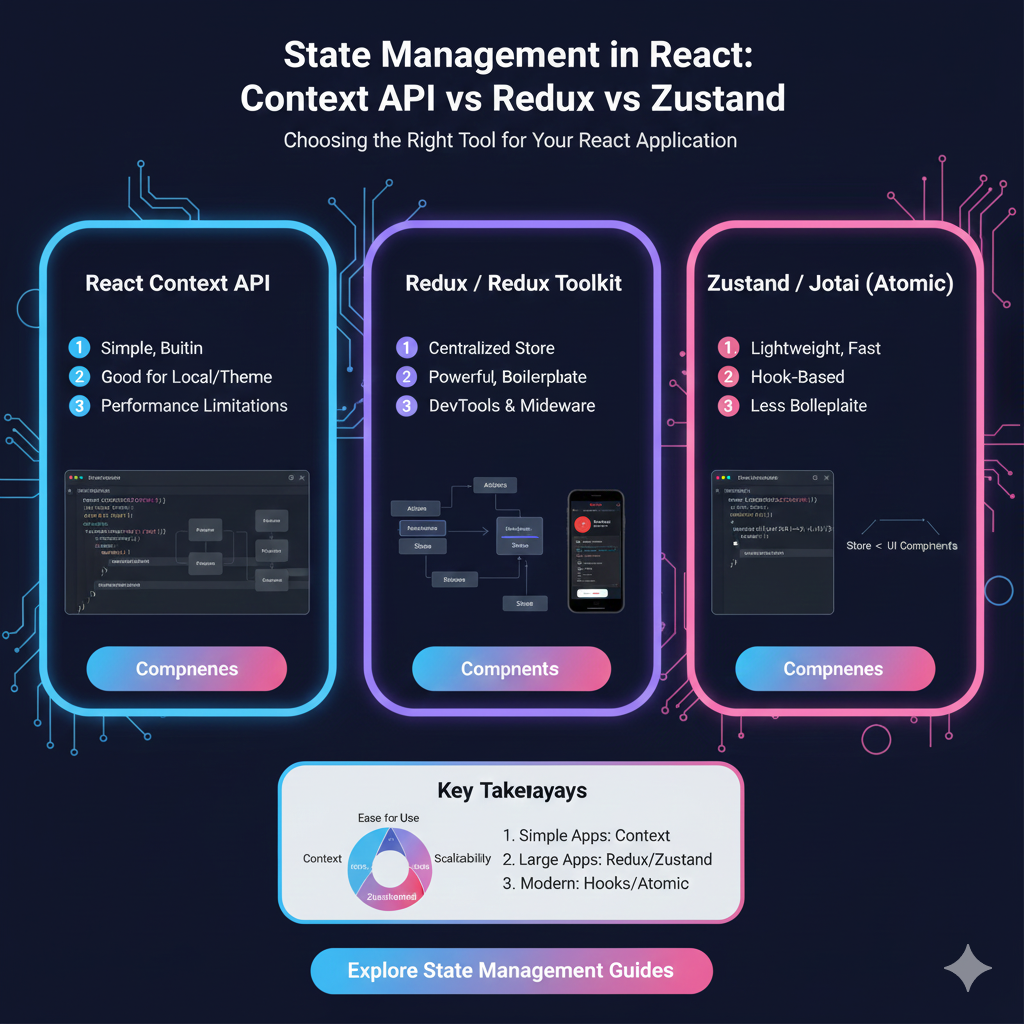
Start with Context API for theme, auth user, or simple static data.
Choose Redux if you’re joining a large existing team, need impeccable state traceability, or are working on an extremely complex, data-intensive application.
Pick Zustand for almost everything else. It’s the pragmatic, powerful, and joyful choice for most new projects today.
The Golden Rule: Don’t choose a tool because it’s trendy. Choose the simplest tool that cleanly solves your specific problem. Over-engineering is a bigger sin than under-engineering.
Mastering state management is a core pillar of becoming a proficient React developer. It’s the difference between a janky, bug-riddled app and a smooth, scalable one. To dive deeper into these concepts and build production-ready applications, consider structured learning. To learn professional software development courses such as Python Programming, Full Stack Development, and MERN Stack with hands-on projects covering React, state management, and beyond, visit and enroll today at codercrafter.in. Build something awesome