AWS Cloud Practitioner vs Solutions Architect 2026: Complete beginner's guide. Compare costs, exams, salaries, and which certification is right for your career goals.
Let’s be honest. If you’ve been anywhere near the tech world lately, you’ve probably heard the acronym "AWS" thrown around like confetti. Maybe you’ve seen job postings asking for it, or perhaps your LinkedIn feed is full of people flexing their "AWS Certified" badges.
And now you’re thinking: "Should I get one of those? But which one? And what do all these fancy words even mean?"
I’ve been there. The world of cloud computing can feel like a secret club where everyone knows the password except you. But here’s the good news: AWS certifications are not just for hardcore programmers. In 2026, they’re for regular people who want better jobs, higher salaries, and a skillset that doesn't expire.
This guide is going to walk you through the two big ones—AWS Cloud Practitioner and AWS Solutions Architect—in plain English. No technobabble. No assuming you already know things. Just the facts, the feelings, and the truth about what these certifications can (and can’t) do for you.
First, What the Heck Is AWS?
Before we talk about certifications, let’s talk about AWS itself.
AWS stands for Amazon Web Services. Remember how Amazon started as an online bookstore? Well, somewhere along the way, they realized they were really good at running massive computer systems. So they started renting out that capability to other companies .
Think of it like this: instead of buying your own expensive servers and hiring a team to maintain them in a dusty server room, you can just rent space and power from Amazon. You pay for what you use, like electricity or water. It’s called "the cloud," and AWS is the biggest provider of it on the planet .
Today, everything from Netflix to your favorite gaming app to massive government systems runs on AWS. And someone has to build, manage, and secure all of that. That someone could be you.
Why Bother Getting Certified in 2026?
Here’s the honest truth: the cloud job market in 2026 is competitive, but it’s also hungry. Most serious companies are now "cloud-first" by default. They’re not asking if they should move to the cloud; they’re asking how to do it better .
Employers use certifications as a shortcut. When they see "AWS Certified" on your resume, they don’t have to guess whether you know your stuff. It’s a signal that you understand how to build, secure, and optimize systems on the world’s biggest cloud platform.
Plus, there’s the money angle. Certified professionals often earn significantly more than their non-certified peers. It’s not just a piece of paper—it’s a career move.
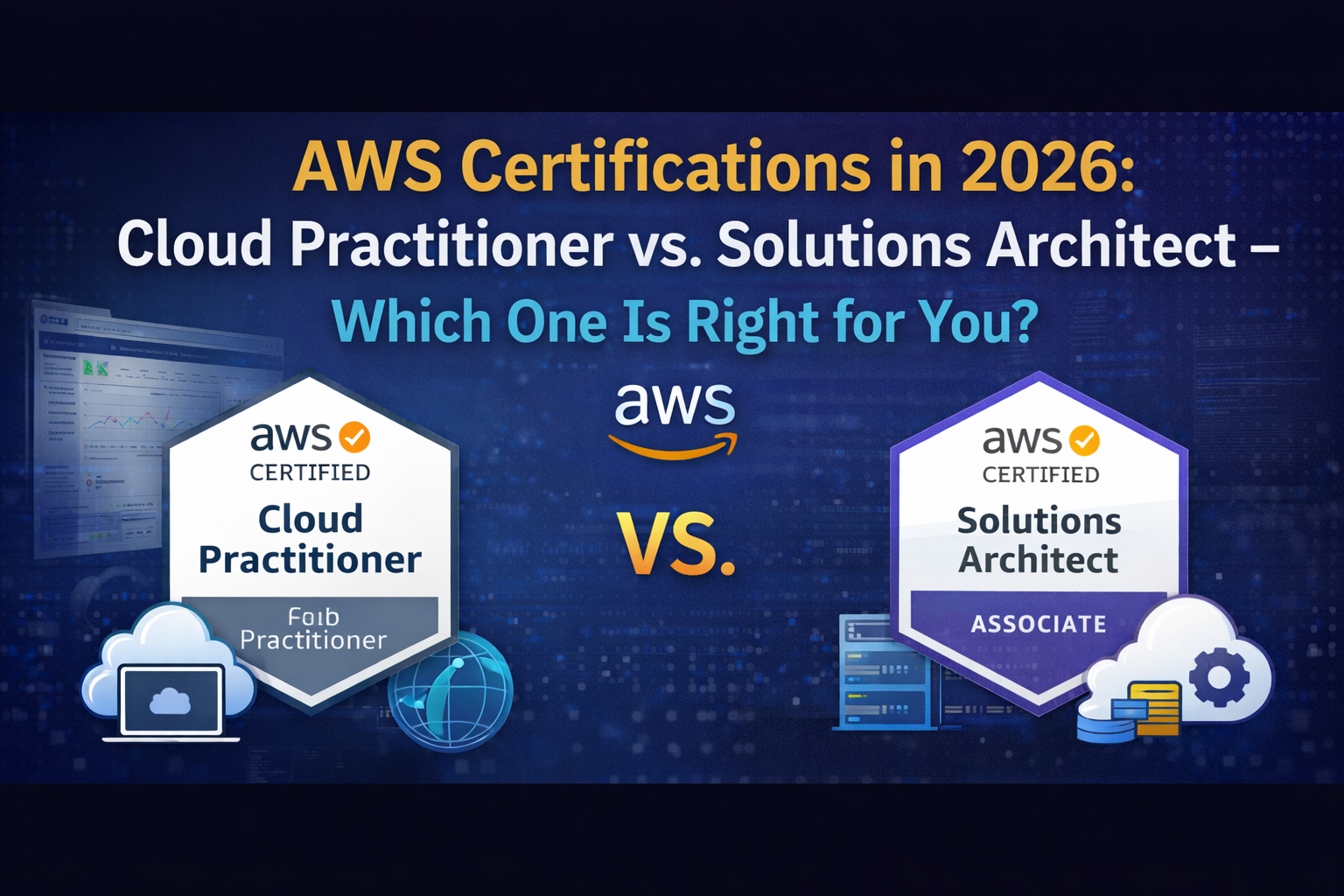
The Two Big Contenders: Cloud Practitioner vs. Solutions Architect
AWS offers a whole bunch of certifications, but if you’re just starting out, your path will likely lead you to one of these two:
AWS Certified Cloud Practitioner (The "starter" certification)
AWS Certified Solutions Architect – Associate (The "real deal" certification)
They serve different purposes, target different people, and lead to different careers. Let’s break them down like we’re comparing two different paths up a mountain.
AWS Certified Cloud Practitioner: Your Friendly On-Ramp
Who Is This For?
Imagine you’re standing at the bottom of a mountain, looking up at the cloud-covered peak. You’re not sure you even want to climb it yet—you just want to know what’s up there.
That’s the Cloud Practitioner.
This certification is designed for absolute beginners. You don’t need any IT experience. You don’t need to be a programmer. You don’t even need to have logged into AWS before . AWS itself says this cert is for people who want a "fundamental understanding" of the cloud.
Who actually takes this exam?
Business folks (sales, product managers, marketers) who work with technical teams and need to speak their language
Managers who approve cloud budgets and need to understand what they’re paying for
Complete career changers who want to dip their toes in the water before diving in
Students building out their resumes
What Will You Learn?
The Cloud Practitioner exam (coded CLF-C02) covers the big picture . Think of it as "AWS 101." You’ll learn:
What cloud computing actually is (and why it matters)
The core AWS services—things like EC2 (virtual servers), S3 (storage), and IAM (security)
How AWS pricing works (because the cloud is not free, and someone has to manage the bill)
The shared responsibility model—basically, what AWS secures for you versus what you have to secure yourself
Basic security and compliance concepts
It’s broad but not deep. You’ll come out knowing the names of the tools and what they do, but probably not how to build a full system from scratch.
The Exam Itself
Let’s get practical. What’s this test actually like?
90 minutes long
65 questions (multiple choice or multiple response)
Costs $100 USD
You can take it at a testing center or online at home
Most people study for about 2–4 weeks part-time and feel ready . It’s not meant to be brutally hard—it’s meant to be accessible.
The Pros and Cons
The Good:
Low barrier to entry—anyone can take it
Gives you a solid foundation
Looks good on a resume if you’re in a non-technical role
Can be a stepping stone to harder certifications
The Not-So-Good:
It won’t land you a technical job on its own
Some tech snobs don’t take it seriously (ignore them—everyone starts somewhere)
You’ll eventually need to move past it if you want to build things
Real Talk: Is It Worth It?
If you have zero cloud knowledge and you’re feeling overwhelmed by technical jargon, yes, the Cloud Practitioner is worth it. It builds confidence. It gives you a map of the territory. And it introduces you to AWS in a way that doesn’t make you want to cry .
But if you’re already working in IT or you’re comfortable with technology, you might be able to skip it and go straight for the Solutions Architect. It depends on where you’re starting from.
AWS Certified Solutions Architect – Associate: The Career Changer
Now let’s talk about the big one.
Who Is This For?
If Cloud Practitioner is the scenic overlook, the Solutions Architect – Associate is the actual climb. This certification is for people who want to design and build things on AWS .
AWS recommends that candidates have at least one year of hands-on experience with AWS before taking this exam . But let’s be real—plenty of people pass it with less, as long as they study hard and do the labs.
This cert is ideal for:
IT professionals who want to move into cloud roles
Developers who want to understand the infrastructure their code runs on
Sysadmins transitioning from on-premise servers to the cloud
Career changers who’ve done their homework and are ready to get serious
What Will You Learn?
This is where things get meaty. The Solutions Architect exam tests your ability to design secure, resilient, and cost-effective systems on AWS . You’ll need to understand:
Compute (EC2, Lambda, containers)—how to choose the right server for the job
Storage (S3, EBS, EFS)—where to put your data and why
Databases (RDS, DynamoDB, Aurora)—which database fits which use case
Networking (VPC, load balancers, DNS)—how to connect everything securely
Security (IAM, KMS, encryption)—how to keep the bad guys out
Pricing and cost optimization—because the cloud can get expensive fast if you don’t know what you’re doing
You’re not just memorizing service names. You’re learning how to make trade-offs. Should you use a relational database or a NoSQL one? Should you pay for reserved instances or gamble on spot pricing? These are the kinds of decisions architects make every day.
The Exam Itself
The Solutions Architect – Associate exam (coded SAA-C03) is a step up in difficulty.
130 minutes long
65 questions
Costs $150 USD
Requires deeper knowledge and scenario-based thinking
Study timelines vary, but most people dedicate 2–3 months of consistent effort . You’ll want to do more than just read—you’ll need hands-on practice in the AWS console.
The Pros and Cons
The Good:
One of the most recognized IT certifications in the world
Opens doors to roles like Cloud Engineer, Solutions Architect, and DevOps Engineer
Average salaries often exceed $130,000 in the U.S.
Gives you real, applicable skills
The Not-So-Good:
Requires significant study time
Can feel overwhelming if you’re brand new to tech
You’ll need to stay current—AWS changes fast
Real Talk: Is It Worth It?
Absolutely. If you’re serious about a career in cloud computing, the Solutions Architect – Associate is the certification that employers actually look for . It tells them you can do more than talk about the cloud—you can build in it.
But here’s the honest part: passing the exam doesn’t automatically make you a great architect. You still need hands-on experience. You still need to build stuff. The certification opens the door, but your skills keep you in the room .
Head-to-Head: Cloud Practitioner vs. Solutions Architect
Let’s put them side by side so you can see the difference at a glance.
Feature | Cloud Practitioner | Solutions Architect – Associate |
|---|---|---|
Target Audience | Beginners, business roles, managers | IT professionals, developers, aspiring architects |
Prerequisites | None | ~1 year AWS experience recommended |
Focus | Broad overview | Deep technical design |
Exam Length | 90 minutes | 130 minutes |
Cost | $100 USD | $150 USD |
Difficulty | Entry-level | Intermediate |
Career Impact | Foundational knowledge | Direct job opportunities |
Typical Study Time | 2–4 weeks | 2–3 months |
The New Kid on the Block: AI Certifications
Before we wrap up, I have to mention something that’s changed the game in 2026. AWS has been rolling out AI and machine learning certifications like crazy .
Why? Because AI isn’t just a buzzword anymore—it’s baked into everything. Companies are building chatbots, recommendation engines, and automated systems on AWS, and they need people who understand both the cloud and AI .
If you’re just starting out, you might also look at:
AWS Certified AI Practitioner – a foundational AI cert that pairs well with Cloud Practitioner
AWS Certified Machine Learning Engineer – Associate – for those who want to get hands-on with AI workloads
But don’t get distracted. For most people, the path is still: Cloud Practitioner → Solutions Architect → Specialization .
How to Choose: A Simple Framework
Still not sure which one to pick? Ask yourself these questions:
1. How much do you know about tech right now?
If the answer is "almost nothing," start with Cloud Practitioner. If you’ve already worked in IT or you’re comfortable with computers, aim for Solutions Architect.
2. What’s your goal?
If you need to understand AWS for a non-technical job (sales, management, etc.), Cloud Practitioner is enough . If you want to build things and get a technical job, you need Solutions Architect.
3. How much time can you commit?
Got a few weeks? Cloud Practitioner. Got a few months? Solutions Architect.
4. Are you willing to get hands-on?
If you’re the type who learns by doing (and you should be), Solutions Architect will force you into the AWS console. That’s a good thing.
Practical Tips for Passing Your Exam
Whichever path you choose, here’s some advice from people who’ve been through it:
For Cloud Practitioner:
Use AWS’s free digital training on AWS Skill Builder
Take the official practice exam to see where you stand
Focus on understanding concepts, not memorizing service details
Know the pricing models—billing questions show up frequently
For Solutions Architect:
Get your hands dirty. Use the AWS Free Tier to launch servers, create storage buckets, and build networks. Reading alone won’t cut it .
Study the AWS Well-Architected Framework—it’s the blueprint for good design
Take practice exams under timed conditions
Understand why you’d choose one service over another, not just what each service does
Read the questions carefully. On the real exam, two answers might look correct, but only one fits the specific scenario
What Happens After You Pass?
Congratulations—you’re certified! Now what?
For Cloud Practitioner holders: You’ve got the foundation. If you’re in a business role, use your knowledge to communicate better with your tech team. If you’re aiming for a technical career, start studying for Solutions Architect. The Cloud Practitioner is a great first step, but it’s not a destination .
For Solutions Architect holders: Update your LinkedIn (badge and all), update your resume, and start applying for roles that excite you. Remember that certification plus experience equals unstoppable. Keep building projects, keep learning, and consider where you want to specialize—security, DevOps, data engineering, or AI .
And here’s a nice perk: once you have one AWS certification, you get a 50% discount on your next exam . So if you’re hungry for more, the next one costs less.
The Honest Truth
I’m not going to tell you that getting certified will magically fix your career overnight. It won’t. You still have to network, apply for jobs, and prove yourself in interviews.
But I will tell you this: AWS certifications open doors. They give you credibility. They prove you’re serious enough to invest time and money in your skills. And in a world where cloud computing is only growing, they’re about as safe a bet as you can make .
Whether you start with Cloud Practitioner or go straight for Solutions Architect depends on you. Be honest about where you are, be realistic about your goals, and take the first step.
The cloud isn’t going anywhere. And neither, hopefully, are you.