Firebase Cloud Storage: The Ultimate Guide for App Developers (2025)
Struggling with user file uploads? Learn how Firebase Cloud Storage works with real-world examples, code snippets, security best practices, and FAQs. Scale your app effortlessly. Learn more at CoderCrafter.
Your App's Digital Warehouse: Mastering Firebase Cloud Storage
Alright, let's cut through the buzzwords. You're building an app—maybe the next big thing, maybe a passion project. Users are going to upload stuff: profile pics, hilarious memes, 4K videos of their cat, important documents. Where does all that stuff go? You can't just stash it on your laptop. This is where Firebase Cloud Storage comes in, and honestly, it’s a game-changer.
Think of it like this: if Firebase Realtime Database or Firestore is your app's sleek, organized filing cabinet for data (text, numbers, booleans), then Cloud Storage is your massive, secure, industrial-grade warehouse for all the bulky, messy, binary files. It's built on Google Cloud Platform, so it's the same infrastructure that powers YouTube and Gmail. Pretty solid foundation, right?
So, What Exactly Is Firebase Cloud Storage?
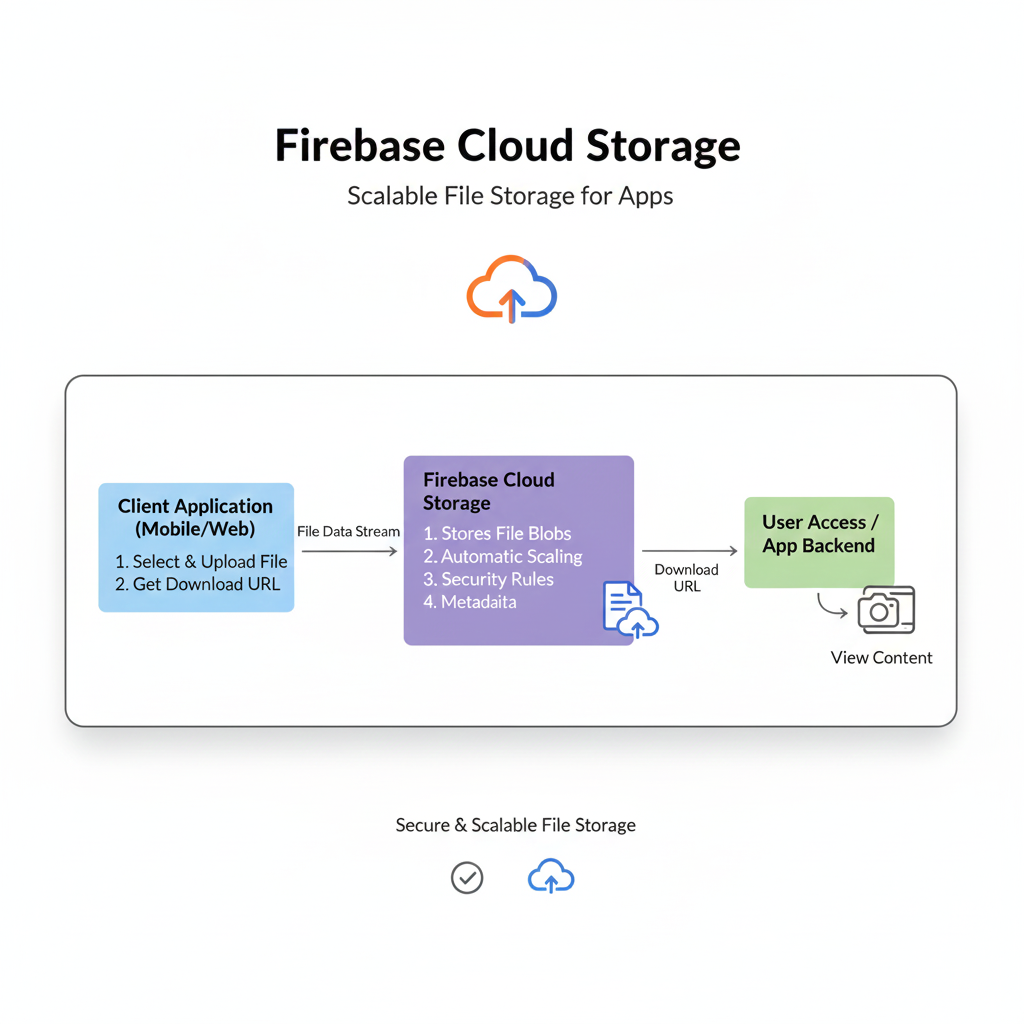
In simple terms, Firebase Cloud Storage is a powerful, simple, and cost-effective object storage service designed for developers. It lets your app's users upload and download files directly from a Google Cloud bucket, with Firebase handling all the nasty security, networking, and scaling headaches.
The "object storage" part is key. Unlike a database that stores rows and columns, it stores "objects" (your files) in a flat structure within "buckets." Each file is just a URL. This makes it incredibly fast and scalable for serving images, videos, and downloads.
Why Should You Even Care? The Killer Features.
Serverless File Handling: You don't need to manage your own file servers. No more worrying about disk space, bandwidth limits, or server crashes when your app goes viral.
Built for Scale: From your first 100 users to your first 10 million, it scales automatically. Google's infrastructure has your back.
Robust Security: This is the big one. You secure your files using Firebase Security Rules—the same way you secure your Firestore data. You can write rules like: "Only logged-in users can upload," or "Users can only delete their own profile pictures."
Strong Consistency: When a file is uploaded, it's immediately available for download everywhere. No outdated caches causing confusion.
Google Cloud Power: It’s essentially a super-friendly wrapper around Google Cloud Storage. You get features like multiple storage regions, integrated CDN (Content Delivery Network) for fast global downloads, and easy access to Google's machine learning APIs (like labeling images or transcribing video audio).
Awesome SDKs: The Firebase SDKs (for Web, Android, iOS, and Flutter) make integration stupidly simple. A few lines of code, and you're handling file uploads with progress bars.
Real Talk: Where Would You Actually Use This?
Let's move past theory. Here’s how apps you use daily (or could build) leverage Cloud Storage:
Social Media App (like Instagram): Every story, reel, and profile picture. The upload progress bar you see? That's the SDK in action, and the file ends up in Cloud Storage.
Content Platform (like a blog or course site): Hosting PDF e-books, video lessons, and podcast episodes. Speaking of which, if you're looking to build the next great learning platform, you'll need skills like this. To learn professional software development courses such as Python Programming, Full Stack Development, and MERN Stack, visit and enroll today at codercrafter.in.
SaaS Tool (like Canva or Figma): Storing user-created design templates, project files, and exported assets.
Messaging App (like WhatsApp): All those "This photo was deleted" places originally held images, videos, and voice notes sent between users.
E-commerce App: Product images, user review photos, and instruction manuals.
Let's Get Our Hands Dirty: A Quick Code Snippet
Imagine letting a user upload a profile picture. Here’s a super-simplified version with the Firebase Web SDK (v9 modular style):
javascript
import { getStorage, ref, uploadBytes, getDownloadURL } from "firebase/storage";

// Get the storage instance
const storage = getStorage();

// Create a reference to the file location, e.g., 'profilePics/userId123.jpg'
const storageRef = ref(storage, `profilePics/${currentUser.uid}.jpg`);

// 'file' comes from an <input type="file"> element
const file = selectedFile;

// Upload the file
uploadBytes(storageRef, file).then((snapshot) => {
  console.log('Uploaded a blob or file!');
  // Get the public download URL
  getDownloadURL(snapshot.ref).then((downloadURL) => {
    console.log('File available at', downloadURL);
    // Now save this URL to the user's document in Firestore!
    // updateDoc(doc(firestore, "users", currentUser.uid), {profilePic: downloadURL});
  });
});
See? Not rocket science. The real magic is in the Security Rules.
Your Security Rulebook: Non-Negotiable Best Practices
Never leave your storage bucket open to the world. Always write rules. Here's a template to build from:
rules
rules_version = '2';
service firebase.storage {
  match /b/{bucket}/o {
    // Allow public read for all files (e.g., for a blog)
    // match /public/{allPaths=**} {
    //   allow read;
    //   allow write: if false; // Never let public write
    // }

    // User-specific folders: Only the owner can manage their files
    match /userUploads/{userId}/{allPaths=**} {
      allow read: if request.auth != null; // Any logged-in user can read
      allow write: if request.auth != null && request.auth.uid == userId;
    }

    // Profile pics: User can manage their own, everyone can view
    match /profilePics/{userId}.jpg {
      allow read;
      allow write: if request.auth != null && request.auth.uid == userId;
      allow delete: if false; // Or set to same as write to allow deletion
    }
  }
}
Other Pro-Tips:
Use Appropriate File Names: Use unique identifiers (like
userIdoruuid) instead of original filenames to avoid collisions and security issues.Set Metadata: You can set content-type on upload (e.g.,
image/jpeg) so browsers handle files correctly.Resize Images on Upload: For images, consider using a Cloud Function to automatically create optimized thumbnails upon upload. Saves bandwidth and loading time.
Clean Up: Use Cloud Functions to delete files from storage when the corresponding database record (e.g., a post) is deleted.
FAQs: Stuff You're Probably Wondering
Q: How much does it cost?
A: It's pay-as-you-go. You pay for the amount of data stored, bandwidth used for downloads, and operations (like uploads/deletes). The free tier is very generous for starting out. Always check the latest pricing page.
Q: Can I use it without Firebase Auth or Firestore?
A: Absolutely! It's a standalone product. You can use it with your own backend or authentication. But the built-in integration with the Firebase ecosystem is where it shines.
Q: Is there a file size limit?
A: Single files can be up to 5 TiB. So, yeah, you're good.
Q: How do I organize my files?
A: Use a logical folder-like structure in your file paths: posts/{postId}/images/{imageId}.jpg, users/{userId}/docs/{filename}. This makes rules easier to write.
Q: My app is for sensitive documents. Is it secure?
A: Yes, with proper security rules. For extremely sensitive data, you can use Security Rules to allow uploads but disallow all reads, and then generate short-lived signed URLs via a trusted server (like a Cloud Function) to grant temporary access.
Wrapping It Up
Firebase Cloud Storage removes one of the biggest bottlenecks in modern app development: handling user-generated content. It’s not just a "nice-to-have"; for any app that deals with media, it's essential infrastructure. It lets you, the developer, focus on building your app's unique features instead of becoming a systems administrator.
The learning curve is gentle, especially if you're already in the Firebase ecosystem. And the payoff in terms of saved time, reliability, and scalability is enormous. Want to build the kind of apps that need this powerful tech? The journey starts with the right skills. To learn professional software development courses such as Python Programming, Full Stack Development, and MERN Stack, visit and enroll today at codercrafter.in.
So, go ahead. Let your users upload that 4K cat video. Firebase Cloud Storage has got you covered.