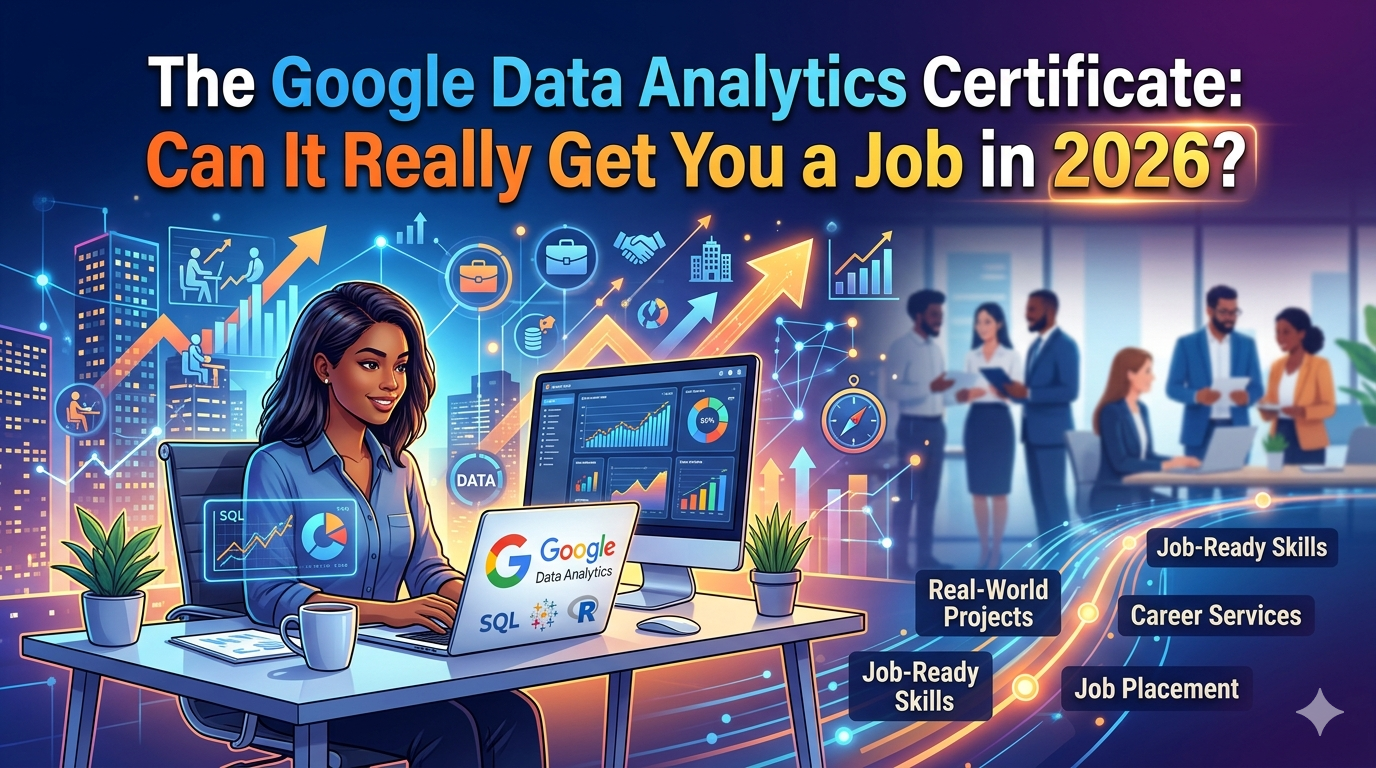
Honest Google Data Analytics Certificate review for 2026. Learn if this $39/month course lands jobs, what you'll study, and if it's worth it for beginners. No fluff.
Let’s be real for a second. You’re probably here because you’ve seen the ads. You know the ones—the happy people who took a Google course and suddenly landed a dream job working from a coffee shop. It sounds too good to be true, right?
If you’re feeling stuck in your current job, or you’re fresh out of school and have no idea what comes next, the idea of a "certificate" can feel like a lifeline. But you’ve also got that skeptical voice in your head: "Is this actually legit, or is it just another way for the internet to take my money?"
I get it. I’ve been there. So let’s talk about the Google Data Analytics Professional Certificate in plain English. No tech bro jargon. No "synergizing disruptive paradigms." Just the facts about what it is, what you’ll actually learn, and whether it’s worth your time in 2026.
First Things First: What Actually Is a Data Analyst?
Before we talk about the course, we need to talk about the job.
Imagine you’re the manager of a small pizza shop. You notice you’re throwing away a lot of pepperoni at the end of the night. A data analyst is the person who looks at the sales records, figures out that Thursday nights are always slow, and suggests you order less pepperoni on Thursdays. You save money. The shop is happier. That’s data analysis.
Now blow that up to a massive company like Google or Netflix. They have billions of data points. They need people to clean up that data, organize it, find patterns, and tell stories with it. That’s what a data analyst does. You’re a detective, but instead of solving murders, you’re solving "Why did our website traffic drop last Tuesday?"
And here’s the best part: in 2026, companies are drowning in data. There are over 251,000 open jobs in data analytics in the U.S. alone, with entry-level salaries hovering around the $95,000 mark . The demand is real.
So, What is the Google Data Analytics Certificate?
Think of this certificate as your "Data Analysis 101" crash course, taught by the people who actually run data at Google. It’s hosted on a website called Coursera, and it’s designed for one specific type of person: someone who knows nothing about data.
You don’t need a math degree. You don’t need to be a programmer. You just need to be curious.
The program is a collection of 8 (or 9, depending on the track) courses that take you from absolute zero to building a professional portfolio .
Google says it takes about 6 months if you study around 10 hours a week . You can go faster if you binge it on weekends, or slower if life gets in the way.
And the price tag? It’s shockingly reasonable. On Coursera, it’s a monthly subscription (usually around $39-$49 a month), so if you finish in 3-4 months, you’re looking at under $200 total . Some community colleges even bundle it for a flat fee .
"But I'm Bad at Math!" – Why You Should Relax
This is the number one fear I hear from people. "I failed high school algebra, so I guess I can't do this."
Stop right there. You don’t need to be a mathematician to be a data analyst. You just need to be logical.
The Google certificate focuses on practical logic, not theoretical calculus. You’re not going to be deriving complex equations by hand. You’re going to be using tools like spreadsheets to do the heavy lifting for you. If you can follow a recipe to bake a cake, you can follow the steps to analyze data. The course meets you where you are.
The 8-Course Journey: What You’ll Actually Learn
Let’s break down the roadmap. Google splits the certificate into phases. Here’s the "human translation" of what they actually mean.
Phase 1: The Mindset Shift (Courses 1 & 2)
Course 1: Foundations: Data, Data, Everywhere
Course 2: Ask Questions to Make Data-Driven Decisions
The first few weeks are less about computers and more about your brain. They teach you how to think like an analyst.
You learn that data isn't just numbers in a spreadsheet. It’s customer reviews, it’s timestamps, it’s photos. You learn about the "data lifecycle"—how data is born, stored, used, and eventually thrown away.
Most importantly, you learn how to ask the right questions. A bad analyst looks at data and says, "What do I find?" A good analyst looks at data and says, "My boss needs to know if we should launch the purple pizza box or the red one. Let me find the answer." This structured thinking is what separates the "tool users" from the people who actually get hired .
Phase 2: Getting Your Hands Dirty (Courses 3 & 4)
Course 3: Prepare Data for Exploration
Course 4: Process Data from Dirty to Clean
This is where the rubber meets the road. Real-world data is ugly. It’s like a teenager’s bedroom—full of junk, missing socks, and things that don't belong.
In these courses, you learn to clean the room.
You’ll use spreadsheets (Google Sheets or Excel) to find and fix errors.
You’ll learn SQL (pronounced "sequel" or "S-Q-L"). SQL is the language you use to talk to databases. You type
SELECT * FROM PIZZA_ORDERS WHERE TOPPING = 'Pineapple'and the database spits out all the pineapple pizza orders .
Data professionals spend about 70% of their time just cleaning data. It’s not glamorous, but it’s essential. If the data is dirty, your conclusions are garbage. This module teaches you how to be the sanitation worker of the data world—which is actually a very valuable skill.
Phase 3: The Fun Part – Analysis (Courses 5 & 6)
Course 5: Analyze Data to Answer Questions
Course 6: Share Data Through the Art of Visualization
Now you have clean data. What do you do with it?
In Course 5, you start slicing and dicing. You use spreadsheets and SQL to calculate totals, averages, and trends. You start seeing the story hidden in the numbers.
Then comes Course 6, which is my favorite: Visualization.
You get to play with a tool called Tableau. Tableau lets you drag and drop data to create beautiful charts, graphs, and interactive dashboards .
Why does this matter? Because most people (like your future boss) don't want to look at a spreadsheet with 10,000 rows. They want to see a line chart that goes "up and to the right." They want to see a map that shows where their customers live. You become the translator—turning numbers into pictures that tell a story.
Phase 4: Going Deeper with Code (Course 7)
Course 7: Data Analysis with R Programming
Okay, this is the one that scares people. R is a programming language. It sounds intimidating, but stick with me.
Spreadsheets are great, but they have limits. When you have a million rows of data, Excel might crash. R can handle it. R lets you do super complex statistics with just a few lines of text.
The Google course teaches you the basics of R. You don't come out of it a software engineer, but you come out of it able to run analyses that look really impressive on a resume. If you can say "I know R" in an interview, you immediately jump ahead of the people who only know Excel .
A Note for 2026: The course has recently updated to include Python more explicitly as well, and even integrates AI training to help you use tools like ChatGPT to write and debug your code faster . It’s not about cheating; it’s about working smarter.
Phase 5: The Grand Finale (Course 8)
Course 8: Google Data Analytics Capstone
This is your "proof of work." You don’t just get a certificate for watching videos. You have to do a final project.
You pick a case study (like analyzing data from a bike-share company in Chicago) and you run your own analysis from start to finish . You clean the data, you analyze it, you build a dashboard in Tableau, and you write a presentation explaining your findings.
When you finish, you have something to show employers. You can put this project on your resume and on LinkedIn. When an interviewer says, "Do you have any experience?", you don't have to make stuff up. You can say, "Yes, I analyzed 12 months of bike-share data and found that members ride longer on weekends, so we should launch a weekend loyalty campaign." That answer gets you hired.
The Honest Truth: Will This Certificate Get You a Job?
Let’s cut through the hype. The certificate claims that 75% of graduates report a positive career outcome (new job, promotion, or raise) within six months .
That statistic is good, but we have to be smart about what it means.
The Pros (Why it works):
Brand Power: It says "Google" on it. Recruiters recognize that name instantly . It’s not some random online course; it’s a signal that you’re serious.
Portfolio Proof: The capstone project gives you evidence. In a sea of resumes that all look the same, you have a story to tell .
Employer Network: Google has a consortium of over 150 employers (including Deloitte, Target, and Verizon) who have agreed to consider graduates for jobs . That doesn’t mean you’re guaranteed a job, but it means your application won’t be ignored.
The Cons (The Fine Print):
It’s "Entry-Level": This prepares you for junior roles. You’re not going to become a Chief Data Officer overnight. You’re aiming for titles like Junior Data Analyst or Data Associate.
The Python Gap (Sort of): For a long time, the certificate taught R, not Python. Python is the other big programming language in data. The 2026 version has started to fix this by adding Python modules, but you might still want to supplement your learning with a little extra Python practice if you want to be super competitive .
You Still Have to Hustle: The certificate teaches you the skills, but it doesn't apply for jobs for you. You still have to network, write a good resume, and practice interviewing.
Google vs. The Others (Quick Comparison)
How does it stack up against the competition in 2026?
IBM Data Analyst Certificate: This is slightly more technical. If you love coding and want to dive deep into Python, IBM is a strong contender .
Microsoft Power BI Certificate: If you know you want to focus purely on building reports and dashboards in corporate environments, Microsoft’s track is great .
But for the absolute beginner who wants the best balance of theory, practice, and brand recognition, the Google cert is still the king of the hill.
Final Verdict: Should You Click "Enroll"?
If you are curious, you like solving puzzles, and you want a career that pays well and has a future (AI creates data, but it still needs humans to ask the right questions), then yes, this is a fantastic place to start.
It’s low risk. It’s low cost. And it forces you to build a portfolio that proves you can do the work.
Will it be easy? No. There will be moments where you want to throw your laptop out the window because your R code isn't running. But if you push through those moments, you come out the other side with a skill set that is in high demand.
So, go sign up for the free trial. Watch the first week's videos. See if it clicks. You might just be starting the journey to that coffee shop job after all.