Beyond the Hype: How Advanced Data Analytics is Reshaping Industries in 2026
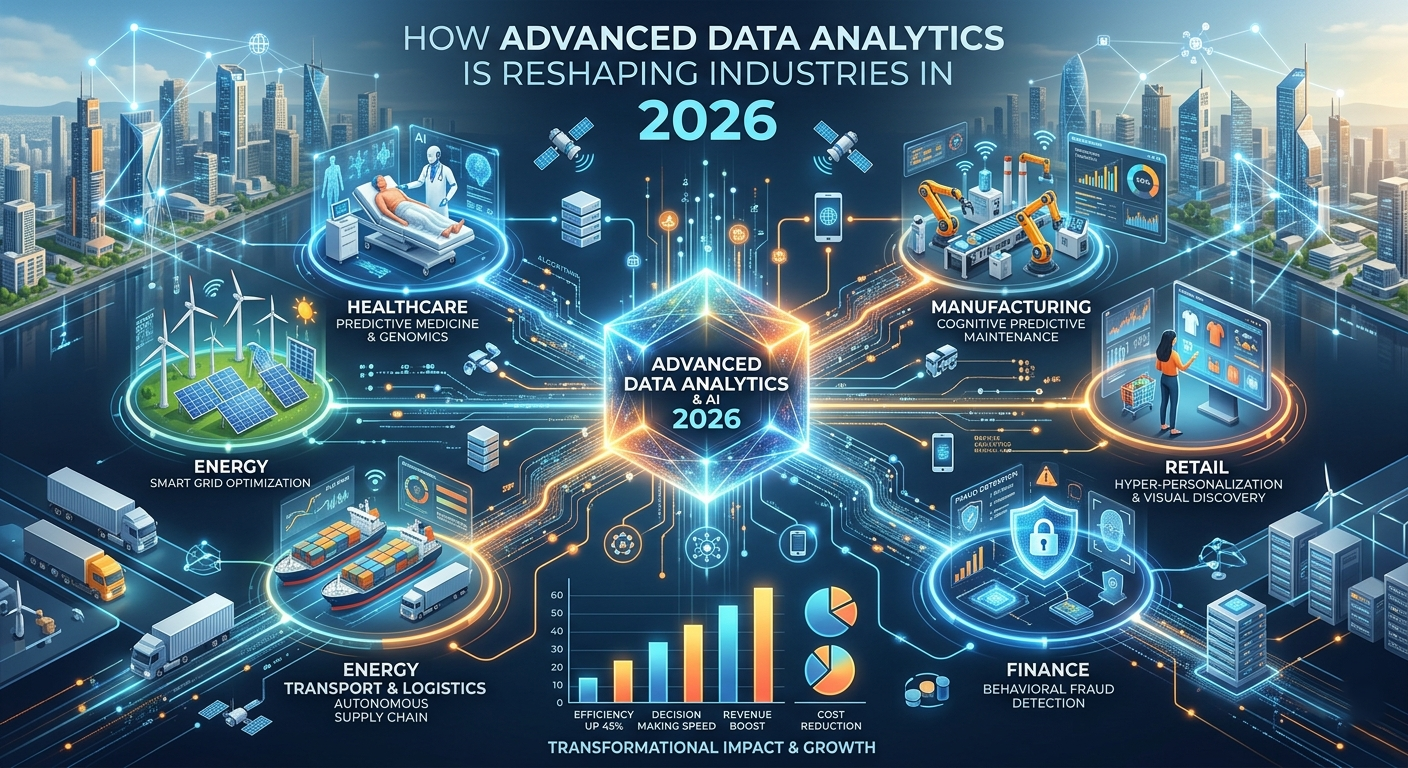
Dive into the world of Advanced Data Analytics. Discover how predictive modeling, AI, and real-time insights are driving smarter business decisions and future-proofing industries.
Introduction
We are living in the age of information, but information alone is not power—insight is. For the past decade, businesses have been busy digitizing their operations, collecting massive amounts of data from customer interactions, supply chains, and internal processes. But for many, that data has remained a dormant asset, sitting in silos, waiting to be awakened. We’ve moved past the era of simple descriptive analytics—the "what happened" reports and dashboards. Today, the competitive edge lies in something far more potent: Advanced Data Analytics.
Advanced Data Analytics is the umbrella term for the high-level techniques and tools used to dig deeper into data, moving beyond basic business intelligence to predict future outcomes, prescribe actions, and automate decisions. It is the difference between looking in the rearview mirror and having a GPS-guided, heads-up display for your entire enterprise.
In 2026, this field has transitioned from a "nice-to-have" for tech giants to a necessity for survival across every sector. Whether it’s a retailer predicting supply chain disruptions before they happen, a hospital diagnosing diseases earlier than ever before, or a financial institution stopping fraud in milliseconds, advanced analytics is the common denominator.
However, with great power comes great complexity. Navigating the world of machine learning, natural language processing, and predictive modeling can be daunting. This blog post aims to demystify these concepts. We will explore how Advanced Data Analytics is fundamentally changing the way we approach problems, moving from reactive troubleshooting to proactive strategy. We will look under the hood at the technologies driving this shift and provide a roadmap for how organizations can harness these tools to not just survive, but thrive, in an increasingly uncertain world.
Section 1: The Engine Room – Key Technologies Powering Advanced Analytics
To understand the impact of Advanced Data Analytics, we must first understand the engine driving it. It’s not one single technology but a convergence of several mature fields that together create a sum greater than their parts. Gone are the days when a simple Excel spreadsheet or a static SQL query could answer the complex questions facing modern businesses. Today’s analytics engine runs on three primary cylinders: Machine Learning (ML), Artificial Intelligence (AI), and Big Data processing.
First and foremost is Machine Learning. If traditional analytics relies on humans to ask questions of the data, ML flips the script. It allows algorithms to learn from the data itself. Instead of a data analyst manually checking for correlations, an ML model can ingest millions of data points and identify patterns invisible to the human eye. For instance, in Advanced Data Analytics, supervised learning algorithms are used to train models on historical data to predict future outcomes—like which customers are most likely to churn. Unsupervised learning, on the other hand, can discover hidden customer segments that marketing teams never knew existed, allowing for hyper-personalized campaigns.
Closely related is the broader field of Artificial Intelligence. While ML is about learning patterns, AI is about simulating human intelligence to perform tasks. In analytics, this often manifests as Natural Language Processing (NLP). Imagine querying your company’s database not with a complex query language, but with a simple question: “What were our top-selling products in the Midwest last spring, and why did returns spike?” NLP, powered by AI, can parse this question, find the relevant unstructured data (like customer reviews and return logs), and synthesize an answer. This democratizes data access, allowing non-technical stakeholders to leverage Advanced Data Analytics without needing a PhD in computer science.
Finally, none of this would be possible without the infrastructure to handle the "Three Vs" of Big Data: Volume, Velocity, and Variety. Technologies like Apache Spark and Hadoop, combined with cloud computing platforms (AWS, Azure, Google Cloud), provide the distributed processing power required. Advanced Data Analytics often involves analyzing petabytes of data—from streaming social media feeds to IoT sensor data from manufacturing equipment. The cloud allows companies to scale their computational resources elastically, spinning up massive server clusters to run complex models for a few hours and then shutting them down. This pay-as-you-go model has lowered the barrier to entry, meaning a small startup can now access the same analytical firepower that was once reserved for Fortune 500 companies.
Section 2: From Hindsight to Foresight – Predictive and Prescriptive Analytics
The true value proposition of Advanced Data Analytics lies in its ability to shift a business’s focus from the past to the future. For decades, business intelligence has been largely descriptive. It answers questions like: "How many units did we sell last quarter?" or "What was our revenue in 2023?" While necessary, this is akin to driving while only looking in the rearview mirror. You know where you’ve been, but you have little warning about the sharp turn ahead.
This is where Predictive Analytics takes the wheel. By applying statistical algorithms and machine learning techniques to historical data, predictive analytics forecasts future events with a significant degree of accuracy. It answers the question: "What is likely to happen?" For example, in the insurance industry, companies use predictive models to assess risk profiles for new customers based on thousands of data points, setting premiums that accurately reflect the likelihood of a claim. In retail, predictive analytics powers inventory management. By analyzing weather patterns, social media trends, and historical sales data, algorithms can predict a surge in demand for umbrellas in a specific city before a single raindrop falls, ensuring shelves are stocked just in time.
But what if you could go a step further? What if the system not only told you what was likely to happen but also told you what to do about it? This is the realm of Prescriptive Analytics, the pinnacle of Advanced Data Analytics. Prescriptive analytics uses optimization and simulation algorithms to recommend specific actions. It answers the question: "Given what is likely to happen, what should we do?"
Consider a complex global supply chain. A prescriptive analytics model might predict a high probability of a port strike in Los Angeles in three months based on labor contract negotiations and sentiment analysis of union communications. But it doesn't stop there. The system will then simulate thousands of possible responses—rerouting ships to Seattle, air-freighting critical components, or increasing inventory at midwest distribution centers. It will weigh the costs, risks, and timelines of each option and present a ranked list of recommended actions to the logistics manager. This moves the organization from simply being aware of a potential disruption to proactively mitigating it. By combining the foresight of predictive models with the decision-making power of prescriptive ones, businesses can navigate complexity with a confidence that was previously impossible.
Section 3: Real-World Applications Across Diverse Industries
The theoretical benefits of Advanced Data Analytics are compelling, but its true power is best illustrated through its application in the real world. We are seeing a paradigm shift across nearly every industry as organizations find innovative ways to turn data into dollars, efficiency, and even lives saved.
In healthcare, the impact is nothing short of revolutionary. Advanced analytics is moving beyond administrative efficiency into clinical settings. Machine learning models are being trained on medical imaging data—X-rays, MRIs, and CT scans—to detect anomalies like tumors or fractures with a level of accuracy and speed that can augment (and in some cases surpass) human radiologists. Furthermore, predictive analytics is being used to reduce hospital readmission rates. By analyzing electronic health records, social determinants of health (like housing stability), and historical data, hospitals can identify patients who are at high risk of complications after discharge and proactively schedule follow-up calls or home visits. This application of Advanced Data Analytics not only saves money but, more importantly, saves lives.
Meanwhile, in the financial services sector, the battle against fraud has been transformed. Traditional rule-based fraud detection systems often create high numbers of false positives, frustrating customers by blocking legitimate transactions. Advanced Data Analytics enables a more nuanced approach. AI models analyze a transaction in real-time, considering hundreds of variables: the user’s typical location, the speed of typing during an online purchase, the device being used, and even the time it takes to move from one page to another. If a transaction deviates from this "digital fingerprint" in a way that mimics fraud, it’s flagged. This happens in milliseconds, allowing banks to stop fraudulent activity while letting genuine purchases go through seamlessly.
Finally, look at the manufacturing industry, where the concept of "Industry 4.0" relies heavily on data. By attaching IoT sensors to machinery, companies create a constant stream of data on vibration, temperature, and energy consumption. This feeds into predictive maintenance models. Instead of performing maintenance on a fixed schedule (which can be wasteful) or waiting for a machine to break down (which causes costly downtime), Advanced Data Analytics predicts the exact optimal moment to service a machine. The system might detect a subtle change in vibration patterns that indicates a bearing is beginning to fail, triggering a maintenance alert weeks before a catastrophic breakdown occurs. This shift from reactive repairs to proactive maintenance saves millions in lost productivity and extends the life of capital assets.
Section 4: Navigating the Challenges and Building a Data-Driven Culture
Despite the immense promise of Advanced Data Analytics, the path to becoming a truly data-driven organization is littered with obstacles. It’s a common misconception that buying the latest software or hiring a team of data scientists is a magic bullet. In reality, technology is only one piece of a much larger puzzle. The most sophisticated algorithms in the world are useless if they are built on poor data or if their insights are ignored by decision-makers.
The first major hurdle is data quality and governance. The old adage "garbage in, garbage out" has never been more relevant. Advanced analytics models require vast amounts of clean, consistent, and well-labeled data to function effectively. If a company’s customer data is scattered across five different CRM systems, with inconsistent formatting and duplicate entries, the model’s output will be unreliable. Organizations must invest in robust data governance frameworks that ensure data is accurate, secure, and accessible. This means breaking down data silos between departments and establishing clear protocols for data ownership and maintenance before any advanced modeling begins.
The second challenge is the skills gap and the "black box" problem. There is a severe shortage of professionals who possess both the technical skills to build complex models and the business acumen to apply them effectively. Furthermore, many advanced models, particularly deep learning networks, operate as "black boxes"—they produce accurate predictions, but even their creators struggle to explain how they arrived at that conclusion. In regulated industries like finance and healthcare, this lack of explainability can be a deal-breaker. Building trust in Advanced Data Analytics requires a focus on "Explainable AI" (XAI), which aims to make model outputs more transparent and understandable to human stakeholders.
Finally, and perhaps most critically, is the need to foster a data-driven culture. This is a change management problem, not a technical one. If a seasoned marketing director has relied on their gut instinct for 20 years, they are unlikely to cede decision-making power to an algorithm without a significant shift in mindset. Leadership must champion the use of data, not just in words but in actions. They must create a safe environment where hypotheses are tested, experiments are encouraged, and "failing fast" is seen as a learning opportunity rather than a career-limiting move. For Advanced Data Analytics to deliver ROI, insights must be democratized—delivered to frontline employees in an intuitive format that helps them make better decisions in the moment. It’s about augmenting human intelligence, not replacing it.
Conclusion
As we stand on the cusp of a new era in business intelligence, one thing is abundantly clear: data is no longer just a byproduct of doing business; it is the business. The journey from simple spreadsheets to Advanced Data Analytics represents a fundamental shift in how we interact with the world. We are moving from documenting history to writing it in real-time.
We’ve explored the powerful engine of machine learning and AI that processes information at unfathomable speeds. We’ve seen how predictive and prescriptive analytics allow us to peer around corners, turning uncertainty into a manageable variable. From the hospital bed to the factory floor, the application of these tools is not just optimizing profits but improving human well-being. However, the path is not without its bumps. Success requires more than just technical investment; it demands a commitment to data integrity and, most importantly, a cultural revolution that places data at the heart of every decision.
The organizations that will lead the next decade are not necessarily the ones with the most data, but the ones that ask the smartest questions of that data. Advanced Data Analytics provides the means to find the answers, but the curiosity, creativity, and courage to act on those answers must come from us. The future belongs to those who can listen to what the data is saying—and have the wisdom to respond.